
FirstCare buying journal
Laboratory Eyewash and Safety Showers in Qatar: A Buyer's Checklist
Qatar University's chemical safety guideline asks for an emergency shower and eyewash in every lab, reachable within 10 seconds, with weekly checks. How to turn that into a costed equipment list.
By FirstCare First Aid · Published · Updated
The short answer
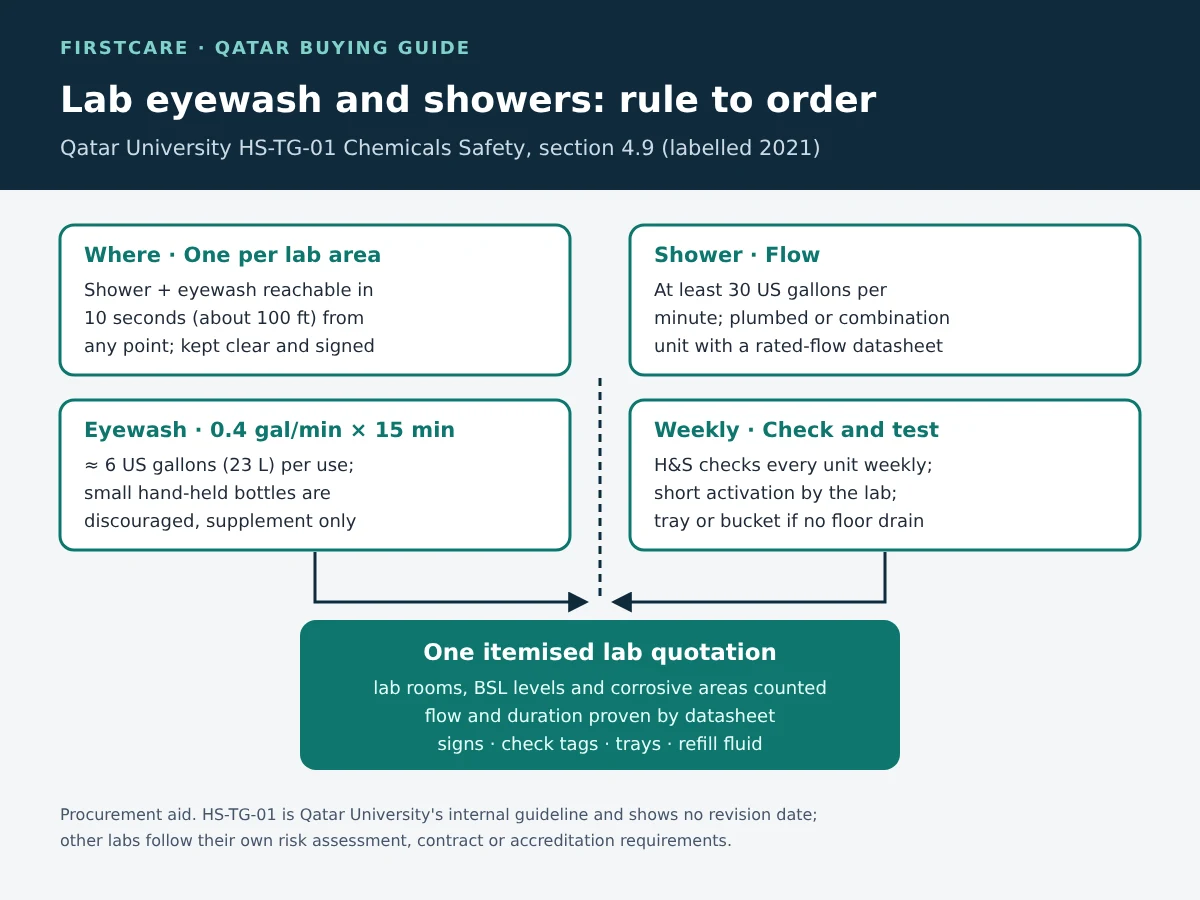
Qatar University's Chemicals Safety guideline (HS-TG-01, 2021) asks for at least one emergency shower and eyewash in each laboratory area, reachable within 10 seconds or about 100 feet of walking from any point in the room, kept clear and signed. It sets a minimum shower flow of 30 US gallons per minute and an eyewash flow of 0.4 gallons per minute for 15 minutes, discourages small hand-held eyewash bottles, and has the lab in charge activate eyewashes regularly and the Health and Safety team check showers and eyewashes every week. It binds Qatar University only, but it is the most detailed public Qatar text we found for planning lab eyewash: count lab rooms, decide plumbed or self-contained units, then ask for datasheets that prove flow and duration.
Which Qatar documents say what
Qatar University publishes its health and safety technical guidelines on its Facilities and General Services site. Two are relevant to eyewash: HS-TG-01 Chemicals Safety, whose scope covers laboratories, workshops, storage areas and other QU work sites where chemicals are involved, and HS-TG-02 Biological Safety. Both files are labelled 2021; neither shows a revision number or issue date in the text, so treat the copy online as a reference and confirm the current version with the institution.
These are one university's internal rules. They do not bind other employers, schools or laboratories in Qatar, and they are not Ministry of Public Health or Ministry of Labour texts. Outside the university, contracts can carry similar duties: QatarEnergy's public contractor standard CORP-HSE-STD-080, for example, asks contractors to provide emergency eye wash where chemicals are used and stored. Your own risk assessment, client contract or accreditation body decides what applies to your site.
How many units: one per lab area, within 10 seconds
Section 4.9 of HS-TG-01 opens: "Each laboratory area must be equipped with at least one emergency shower and eyewash", placed so that it can be reached within 10 seconds or 100 feet of walking from any point in the room. It also asks for the units to be kept free of obstructions and identified with wall signage.
So the count is driven by the floor plan, not by headcount. A single lab with a door between the bench and the corridor unit may still need its own station; a long teaching lab may need two. HS-TG-02 adds that biosafety level 2 labs should have an eyewash station readily available, and level 3 labs one inside the laboratory. Section 4.3 asks for hydrofluoric acid to be handled only where an eyewash and emergency shower are available.
- Walk each lab from its furthest bench to the nearest unit and time it; mark rooms that miss 10 seconds.
- List biosafety level 2 and 3 rooms separately, as the eyewash must be inside BSL-3 labs.
- Mark rooms where hydrofluoric acid or other corrosives are used: they need both shower and eyewash.
- Add a wall sign for each station to the order.
Flow and duration: the numbers a quotation must prove
HS-TG-01 sets two figures. Emergency showers: "Emergency shower water flow shall be at least 30 gallon-per-minute." Eyewash fountains: a gentle flow of temperate, aerated potable water at 0.4 gallons per minute for 15 minutes. At that rate an eyewash uses about 6 US gallons (about 23 litres) in 15 minutes, so a self-contained unit needs at least that much usable fluid, and its datasheet must show it holds the flow for the full time. Capacity on its own does not prove flow.
The guideline discourages small hand-held portable eyewash bottles: they cannot flush both eyes for 15 minutes and can harbour microorganisms. If bottles are used at all, they sit alongside a fountain, not in place of one. Many specifications in the region cite the US standard ANSI/ISEA Z358.1 for these devices; its figures have changed between editions, so state the edition your client or auditor uses and check the quoted model against it.
On smaller screens, scroll sideways within this table. Keyboard: focus the table, then use the left and right arrow keys.
| Item | HS-TG-01 figure or rule | What to ask the supplier for |
|---|---|---|
| Emergency shower | At least 30 US gal/min; one per lab area; clear and signed | Plumbed or combination unit datasheet showing rated flow at your site water pressure |
| Eyewash fountain | 0.4 US gal/min for 15 minutes of temperate, aerated potable water | Rated flow and duration; tempering method if supply water gets hot in summer |
| Self-contained eyewash | Not named; must meet the same flow and 15 minutes | Usable volume (6 US gal is the minimum at 0.4 gal/min), flow test data, fluid change interval |
| Hand-held eyewash bottle | Discouraged; cannot flush both eyes for 15 minutes | Only as a supplement; fluid type and expiry date |
| Signage | Wall signage at each unit | One sign per station |
| Test-water collection | Bucket, tray or other device where there is no floor drain | Drain pan or collection tray compatible with the unit |
Weekly checks and who does them
Under section 4.9 the lab in charge keeps eyewash facilities in the lab and nearby common areas working, and a quick five-second activation verifies water pressure and flushes debris. The Health and Safety team checks each emergency shower and eyewash fountain every week. Where there is no floor drain, test water is caught in buckets, trays or other collection devices rather than left on the floor.
For buyers this means three things on the order: a check tag or log card for each unit, a collection tray where the room has no drain, and, for self-contained units, the fluid or preservative needed to refill after each test and at the maker's change interval. Qatar University's separate first aid process, HS-ERP-01, adds first aid kits on every floor with monthly checks; labs are covered by both.
- One inspection tag or log card per shower and eyewash.
- Collection trays or buckets for rooms without floor drains.
- Refill fluid or preservative for self-contained units, sized to the test and change schedule.
- First aid kits per floor, ordered and refilled under the first aid process, not as part of the eyewash line.
What FirstCare can quote, and what to send
FirstCare's catalogue lists a self-contained eyewash tank with a listed capacity of 9 gallons (about 34 litres) and a 250 ml wash bottle. The tank's maker, rated flow and flushing duration are not in our records yet, so they are confirmed with the datasheet in the quotation; we do not claim it meets any standard until that document is supplied. Plumbed showers and combination units are not catalogue items: ask, and we will say plainly whether we can supply them.
Send the number of lab rooms and their biosafety levels, which rooms use corrosives, whether each room has a water supply and floor drain, the standard and edition your client names, and the delivery address in Qatar. FirstCare handles Qatar enquiries through its UAE contact team; availability, documents, delivery and lead time are confirmed in the written quotation. This guide is a procurement aid, not a health and safety assessment or first aid instruction.
Common questions
How many eyewash stations does a lab in Qatar need?
There is no single Qatar-wide number we could find. Qatar University's HS-TG-01 asks for at least one emergency shower and eyewash in each laboratory area, reachable within 10 seconds or about 100 feet from any point in the room. It applies to Qatar University; other labs follow their own risk assessment, contract or accreditation.
What flow rate should an eyewash and safety shower have?
HS-TG-01 sets at least 30 US gallons per minute for emergency showers and 0.4 gallons per minute for 15 minutes for eyewash fountains. Ask for a datasheet that shows the quoted model meets the figures your specification uses.
Is a portable eyewash bottle enough for a Qatar laboratory?
Qatar University's guideline discourages small hand-held bottles because they cannot flush both eyes for 15 minutes and can harbour microorganisms. Treat bottles as a supplement to a fountain or a self-contained unit with documented flow, not a replacement.
How often are lab eyewash stations checked under the Qatar University guideline?
Every week by the Health and Safety team, with a short activation by the lab in charge to confirm pressure and flush debris. Where there is no floor drain, test water is caught in a bucket or tray.
Related guides and equipment
More Qatar buying guides
- QAPCO Contractor First Aid in Mesaieed: First Aiders, Boxes and the Monthly Box Check
- Football Club and Training Ground First Aid in Qatar: What the QSL Licensing Rules Ask For
- Office and Commercial Building First Aid Kits in Qatar: Floor-by-Floor Placement
- Hotel First Aid in Qatar: What the Qatar Tourism Classification Manuals Ask For
- Lusail Contractor First Aid Boxes: Monthly Inspection, Contents and Records
- First Aid Room Equipment for Qatar Workplaces: Furniture and Supplies Checklist
- Worker Accommodation First Aid in Qatar: Kits, Medical Room and Bus Supplies
- Heat-Stress Supplies for Outdoor Work in Qatar: What to Buy Before Summer
- Workplace Stretchers in Qatar: Folding, Scoop, Basket or Chair?
- Qatar First Aid Kit Quotes: Check the Contents Schedule
Prepared with AI assistance. Procurement information, not clinical instructions or an approval certificate. Requirements depend on the applicable authority and your workplace. Sources, corrections and editorial policy.