
FirstCare buying journal
Heat-Stress Supplies for Outdoor Work in Qatar: What to Buy Before Summer
Turn Qatar's heat-stress decision into a supply list: drinking water containers, cooling wear, shade, WBGT monitoring and first aid boxes, and what to confirm before you order.
By FirstCare First Aid · Published · Updated
The short answer
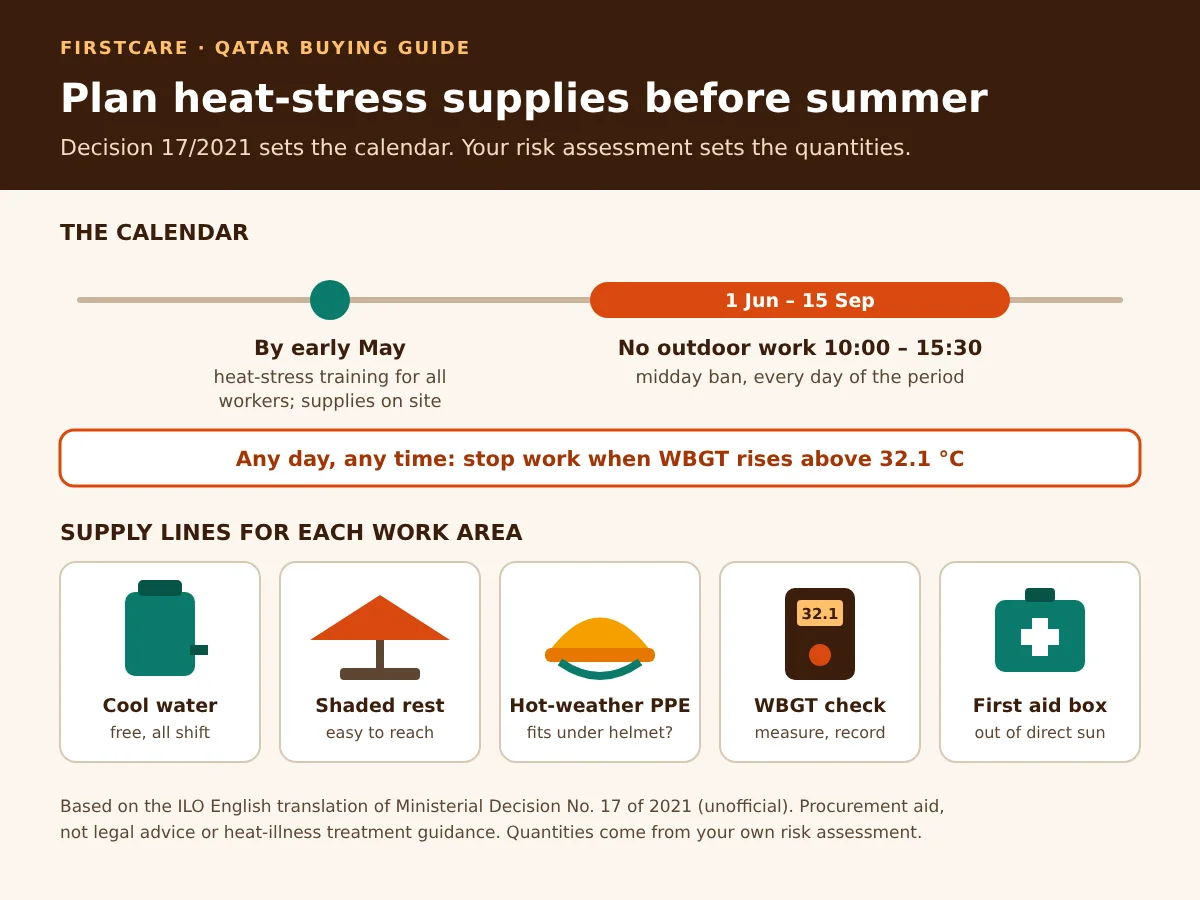
Qatar's Ministerial Decision No. 17 of 2021 bans outdoor work from 10:00 to 15:30 between 1 June and 15 September, and requires work to stop at any time when the WBGT heat index at a workplace rises above 32.1 °C. In the ILO's English translation, employers must also provide free, suitably cool drinking water throughout working time, easily accessible shaded rest areas, protective equipment suited to hot weather, heat-stress training for all workers by the start of May, a heat-stress risk assessment made with workers, and WBGT-based assessment. Build your supply list from those duties, one line per work area, and order early enough for the items to be on site before the May training.
What Qatar's heat-stress decision asks employers to provide
Ministerial Decision No. 17 of 2021 replaced Qatar's earlier summer rule, which banned outdoor work from 11:30 to 15:00 between 15 June and 31 August. Under Article 2 of the 2021 decision, outdoor work is not allowed from 10:00 to 15:30 between 1 June and 15 September, and the ILO reports that all work must stop whenever the wet-bulb globe temperature (WBGT) at a workplace rises above 32.1 °C, whatever the time of day. Qatar's Ministry of Labour announced the same 10:00–15:30 window again for the 2026 season.
Article 4, in the English translation printed in the ILO employer guide, lists what employers must do. Several items are supplies you buy; others are services or records you arrange. Article 3 also requires the daily working schedule to be displayed in a visible place, and Article 6 protects workers who stop work because of heat stress.
The ILO translation is not the official text, which is published in Arabic. The guide itself says its practical recommendations are guidance, not legal requirements. This page is procurement information, not legal advice or a heat-illness treatment guide: first aid for heat illness should follow your medical provider and the training your first aiders receive.
- Art. 4(1): complete a heat-stress risk assessment together with the workers, update it regularly and keep a copy at the workplace.
- Art. 4(2): train all workers on heat stress by the beginning of May each year.
- Art. 4(3): provide free, suitably cool drinking water to all workers throughout working time.
- Art. 4(4): provide shaded rest areas that are easily accessible.
- Art. 4(5): provide personal protective equipment appropriate for hot weather.
- Art. 4(6): arrange annual health checks at no cost to the worker and keep a record.
- Art. 4(7): train paramedics and occupational safety and health supervisors to guide workers and give first aid.
- Art. 4(8): use the WBGT index to assess occupational heat stress.
Ras Laffan, Mesaieed and Dukhan: QatarEnergy's heat index guidelines
QatarEnergy's Industrial Cities Directorate publishes its own heat stress guidelines. QGL-LHH-001 (Rev. 00, 25 October 2015) applies to everyone working outdoors in the Industrial Cities and the Dukhan Concession Area, including contractors and visitors; QGDL-DC-004 (Rev. 01, 2016) is a re-issued version for the Industrial Cities. Both set controls by a heat index measured in full shade with calibrated instruments, not by the WBGT index named in Decision 17 of 2021, so ask the site which measure it uses alongside the national rule.
For purchasing, the guidelines ask for shaded rest areas with green net on all sides and the top and seating to rest, break areas kept 10–15 degrees cooler than the work area, and cool drinking water with glasses or flasks. They allow misting fans at fixed work locations and portable trailer-mounted air conditioning for larger enclosed areas, and say cooling devices such as ice vests need a work assessment first. The two versions give different drinking amounts (200 ml and 250 ml every 20 minutes), so take the figure from the version your site issues. The table summarises the work-rest bands printed in both versions; their first aid sections are clinical and are not covered here.
- Calibrated heat index instruments and a daily way to tell crews the reading: not in our catalogue.
- Colour flags for each band, if the site uses the flagging system: not in our catalogue.
- Insulated water containers and cups or flasks at each rest area: water thermos containers are listed.
- Cooling wear chosen after the work assessment: cooling bandana tube and skull cap are listed.
On smaller screens, scroll sideways within this table. Keyboard: focus the table, then use the left and right arrow keys.
| Heat index band (as printed) | Work : rest (minutes) | Flag | Extra control in the guideline |
|---|---|---|---|
| 27–31 | 50 : 10 | Green (caution) | None added |
| 32–38 | 40 : 10 | Yellow (extreme caution) | No working alone |
| 39–49 | 30 : 10 | Orange (danger) | Work under shade |
| 50–53 | 20 : 10 | Not stated in the band | Stop elevated and confined space work |
| 54 and above | Stop all work | Red (extreme danger) | Emergency or critical work only, 10 : 10 under HSE supervision |
Turn each duty into a supply line
This table is an original planning aid. It maps each supply-related duty to what a purchaser usually has to source, and shows honestly which items FirstCare lists. Quantities come from your own risk assessment, not from this page: we do not set a litres-per-worker or kit-per-crew figure.
On smaller screens, scroll sideways within this table. Keyboard: focus the table, then use the left and right arrow keys.
| Duty in Decision 17/2021 | What purchasing usually has to arrange | In the FirstCare catalogue? | Ask the supplier |
|---|---|---|---|
| Free, suitably cool drinking water throughout working time (Art. 4(3)) | Insulated water containers at each work area, plus a refill and cleaning routine | Yes: 10 L and 20 L thermos containers and a 20 L plastic water thermos | Body and liner material, food-contact suitability, tap type and thermal performance of the exact model |
| Protective equipment suited to hot weather (Art. 4(5)) | Cooling wear and light work clothing chosen with the site's other PPE | Partly: cooling bandana tube and cooling skull cap | Cooling method, sizes, care instructions and fit under the helmet you already use |
| Shaded rest areas that are easy to reach (Art. 4(4)) | Shade structures, seating and ventilation near each work front | No | Source from a shade or site-facilities supplier |
| WBGT index to assess heat stress (Art. 4(8)) | A WBGT monitor or service, with a way to record readings | No | Source from a specialist instrument supplier; ask about calibration and data logging |
| Trained paramedics and OSH supervisors able to give first aid (Art. 4(7)) | Training provider, plus stocked first aid boxes at each work location | Yes for first aid boxes and refills; training is arranged separately | Contents list against your approved schedule, expiry dates and storage conditions |
Plan by work area and shift, not by headcount alone
Article 4(4) says shaded rest areas must be easily accessible, and drinking water has to be available throughout working time. Both point to the same planning unit: the work area. A crew spread over a long road corridor or a large yard may need several water and rest points even if the total headcount is small.
Start from your site plan. Mark each active work front, the nearest shade and the nearest first aid box, then list who refills the water containers on each shift and where they are cleaned. Early-morning and late-afternoon shifts in summer can change the number of people on site at one time, so check the busiest shift, not the daily total.
- Fictional example: a contractor with three work fronts and a site office would list three water points and three shaded rest points near the fronts, keep first aid boxes at the office and at the furthest front, and name one person per shift to refill and clean the containers.
- Keep the site map with the heat-stress risk assessment so inspectors and new supervisors can see where each item is.
- Revisit the plan when the work front moves, not only once a year.
Storage, cleaning and checks in Qatar summer conditions
Water containers that sit in direct sun warm up quickly and are hard to keep clean. Ask for the manufacturer's cleaning instructions and food-contact information before you order, and keep containers in the shade at each water point. Label each container with its work area so it comes back to the same place after cleaning.
Cooling bandanas and caps are reused daily. Follow the supplier's care instructions, keep spares for washing days and replace items that no longer work as described. First aid boxes on outdoor sites should be kept out of direct sun as well; check the storage conditions printed on the supplied contents and include the boxes in your routine inspections. Qatar's Decision No. 16 of 2005 separately requires stocked first aid boxes at each work location.
When to order
The calendar in the decision gives a practical buying window. Training has to be complete by the beginning of May, and the midday ban starts on 1 June. Ordering water containers, cooling wear and first aid refills in the cooler months means the items can be shown during training and are already at each work area when the hot season starts.
The WBGT stop rule applies at any time of year, not only during the June to September ban, so keep heat-stress supplies on site outside the summer window too. After 15 September, check what was lost, damaged or worn out and reorder before the next season rather than at the start of it.
What to send with a Qatar heat-stress supplies enquiry
FirstCare's contact team is based in the UAE. Availability, delivery to Qatar, lead time and documents are confirmed in the written quotation, not assumed from this page.
- Site location (for example Doha, Lusail, Al Wakrah, Al Khor, Mesaieed or Dukhan) and the receiving contact.
- Number of work areas and the busiest shift's headcount at each.
- Water containers: capacity (10 L or 20 L), quantity per work area and any food-contact document your client requires.
- Cooling wear: item, sizes and the helmet or head protection it must fit under.
- First aid boxes or refills per work location, with your approved contents list.
- The date the items must be on site, for example before your May training.
Common questions
When is outdoor work banned in Qatar?
Under Ministerial Decision No. 17 of 2021, outdoor work is not allowed from 10:00 to 15:30 between 1 June and 15 September. Separately, the ILO reports that work must stop at any time when the WBGT index at a workplace rises above 32.1 °C.
Do employers in Qatar have to provide drinking water?
Yes. Article 4(3) of the decision, in the ILO's English translation, requires free and suitably cool drinking water for all workers throughout working time. The official text is in Arabic.
Does FirstCare supply WBGT meters or shade structures?
No, they are not in the FirstCare catalogue. Source them from a specialist supplier. FirstCare lists water containers, cooling wear and first aid boxes and refills.
Can a cooling skull cap be worn under a safety helmet?
It depends on the exact cap and helmet. Ask for the cap's dimensions and check with your helmet manufacturer that wearing it underneath does not affect the helmet's fit.
Do Ras Laffan and Mesaieed sites use a different heat-stress measure?
QatarEnergy's Industrial Cities heat stress guidelines (QGL-LHH-001, 2015, and QGDL-DC-004, 2016) set work-rest bands and flags by a heat index measured in full shade, while Decision 17 of 2021 uses the WBGT index for the national stop-work threshold. Ask the site which measure it applies and follow both where both apply.
Related guides and equipment
More Qatar buying guides
- QAPCO Contractor First Aid in Mesaieed: First Aiders, Boxes and the Monthly Box Check
- Football Club and Training Ground First Aid in Qatar: What the QSL Licensing Rules Ask For
- Office and Commercial Building First Aid Kits in Qatar: Floor-by-Floor Placement
- Laboratory Eyewash and Safety Showers in Qatar: A Buyer's Checklist
- University Campus First Aid in Qatar: Kits per Floor, Monthly Checks and a 31-Item Checklist
- Hotel First Aid in Qatar: What the Qatar Tourism Classification Manuals Ask For
- Lusail Contractor First Aid Boxes: Monthly Inspection, Contents and Records
- First Aid Room Equipment for Qatar Workplaces: Furniture and Supplies Checklist
- Workplace Stretchers in Qatar: Folding, Scoop, Basket or Chair?
- Qatar First Aid Kit Quotes: Check the Contents Schedule
Prepared with AI assistance. Procurement information, not clinical instructions or an approval certificate. Requirements depend on the applicable authority and your workplace. Sources, corrections and editorial policy.