
FirstCare buying journal
Eyewash Bottles and Stations: UAE Buying Checklist
Compare eyewash bottles and stations for UAE workplaces using exact model documents, flow evidence, installation conditions and maintenance handover checks.
By FirstCare First Aid · Published · Updated
The short answer
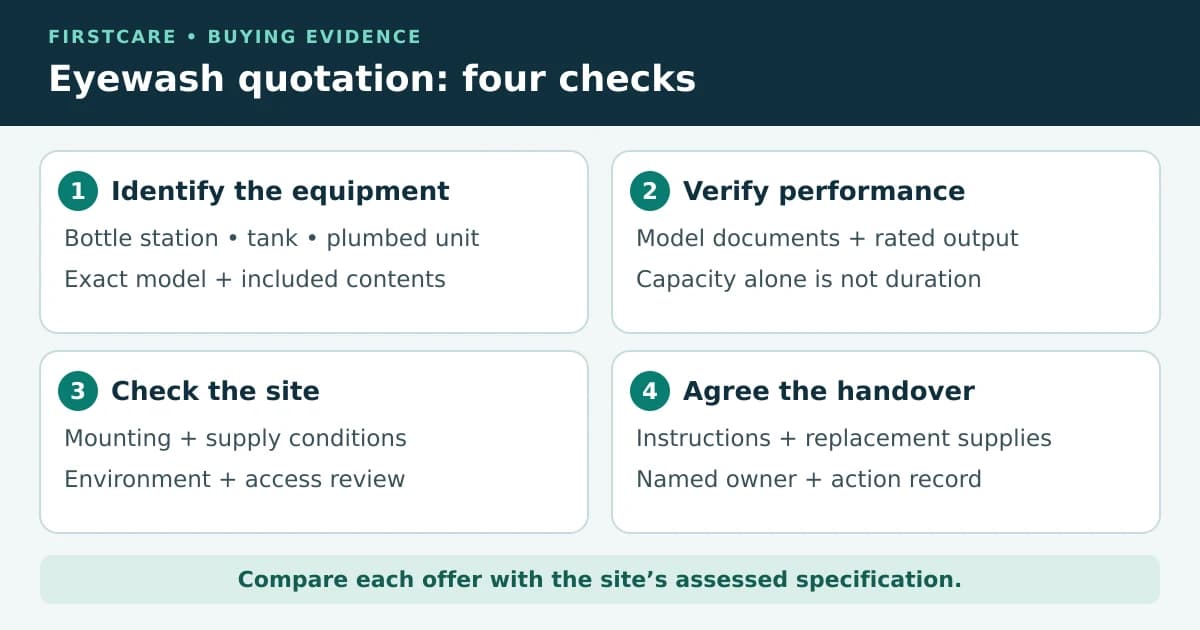
Before ordering an eyewash station in the UAE, match the exact model to your site’s assessed requirements. Confirm the equipment type, documented performance, installation conditions and maintenance supplies. A station label, bottle count or tank capacity alone cannot establish that an offer meets the specification.
Start with the site requirement and safety data sheets
Ask the responsible safety person to define the provision needed for the actual hazards and work areas before comparing products. Keep the relevant chemical safety data sheets (SDS), site assessment and applicable authority or project requirements together. Separate eyewash equipment from the ordinary first aid kit contents schedule.
For Abu Dhabi hazardous-material workplaces, ADPHC’s ADOSH-SF CoP 1.0, version 4.0 (15 July 2024), section 3.1.1 requires a risk assessment, consideration of manufacturer SDS and an emergency response plan. This is scoped Abu Dhabi background; it does not establish one eyewash model or a universal UAE/GCC station specification.
For another emirate or GCC country, have the responsible person confirm the applicable requirements for that site. This guide helps prepare a purchase enquiry; clinical response and equipment selection for a particular exposure belong in the site’s qualified safety arrangements.
Identify what the word station includes
Ask whether the quotation is for a bottle holder with consumables, a self-contained tank, or a plumbed unit. Record the manufacturer, exact model and configuration. Similar catalogue names do not make these offers interchangeable.
For example, Cederroth’s Eye Wash Station REF 721500 lists two 500 ml bottles, REF 725200, within its contents. That is a concrete bottle-station configuration. It should not be read as evidence about a tank unit, another brand or the equipment required at your site.
| Offer type | Clarification to request |
|---|---|
| Bottle station | Exact bottle references, quantities, holder contents and replacement products. |
| Self-contained tank | Exact model, rated output and duration, filling requirements and maintenance materials. |
| Plumbed unit | Exact model and installation specification, including required supply conditions and site connections. |
Read capacity and performance as separate fields
As a manufacturer example, the Haws model 7500 specification lists a 16-gallon (60.6 L) tank and separately states a flow of 0.4 gallons per minute (1.5 L/min) over 15 minutes. These are published equipment specifications for that model, not treatment instructions or a universal UAE legal minimum.
Our purchasing conclusion is to request the offered model’s performance document rather than infer performance from litres. Dividing tank capacity by an assumed flow does not prove tested operating duration or conformity. Ask which standard and edition any compliance claim covers, and request supporting documentation identifying the offered model.
The Haws example does not identify the manufacturer of FirstCare’s 34 L catalogue listing or establish FirstCare stock. Confirm the actual offered product in writing.
Check installation and environmental limits before ordering
A quote can match the requested capacity while leaving the installation unresolved. Send the proposed location and relevant conditions to the supplier. Obtain the model’s mounting, access, water or filling, and environmental requirements for the safety and facilities teams to review.
The linked Haws 7500 manual illustrates why this matters: page 2 addresses support for the filled unit, distinguishes the supplied bracket from mounting hardware, and warns against internal or ambient temperatures above 38°C and exposure to direct sunlight. These conditions belong to that model; do not transfer them to another product or assume an optional cover changes its limits.
- Identify the exact mounting location and who confirms its suitability for the filled equipment.
- List installation work, fixings, utilities and accessories as included, excluded or awaiting confirmation.
- Check actual conditions during occupied and unattended periods against the offered model’s instructions.
- Assign installation, commissioning and acceptance responsibilities before closing the order.
Resolve two incomplete offers before comparing price
Illustrative enquiry: one offer says “eyewash station, two 500 ml bottles”; another says “34 L eyewash tank”. Neither includes a model-specific performance document or installation plan. These are hypothetical quotation descriptions, not FirstCare offers.
The first description identifies a bottle quantity and the second a tank capacity. Neither establishes that it meets the site’s assessed provision. Keep both pending until the missing evidence is supplied and reviewed. Do not select the larger volume simply because the numerical capacity is higher.
| Missing evidence | What closes the question |
|---|---|
| Product identity | Manufacturer, exact model, configuration and current instructions. |
| Required performance | Documented output and duration, plus the evidence needed by the site specification. |
| Site fit | Reviewed installation and environmental conditions for the proposed location. |
| Complete supply | Itemised equipment, consumables, accessories, installation and exclusions. |
| Ongoing readiness | Named owner, model-specific maintenance plan and replacement-supply arrangements. |
Include maintenance supplies and handover in the order
Build the handover file while requesting the quote. Keep the delivered model and serial or batch information where applicable, instructions and revision, installation acceptance, and the person responsible for the next check. Record unresolved actions separately from receipt of the goods.
Ask the supplier to identify compatible replacement bottles or the tank’s specified filling and maintenance materials, with their references and availability to be confirmed. Obtain the actual model instructions for inspection, cleaning and replacement intervals. A sealed-bottle expiry date and a tank maintenance schedule answer different questions; do not invent one interval for all equipment.
Have the responsible person establish the arrangement while equipment is being serviced or replaced. The following purchasing record can be kept with the approved specification: station ID, model, document revision, required consumables, responsible owner, next action and closure evidence. It is an editorial checklist, not an official inspection form.
Send an enquiry that can receive a specific answer
Include the delivery country and emirate or city, work area, approved equipment specification, proposed installation location, quantity and required document set. Ask for model-specific evidence and a clear list of exclusions before accepting substitutions.
FirstCare’s 9-gallon / 34 L eyewash tank listing is an enquiry starting point. Request its exact manufacturer and model, flow and duration documentation, installation instructions and maintenance requirements. Do not assign the Haws example’s specifications to that listing. Confirm price, availability and delivery scope in the written quotation.
Common questions
Does an eyewash station label tell me what I am buying?
No. Ask for the exact manufacturer, model and configuration. A bottle station, self-contained tank and plumbed unit can have different contents, performance and installation requirements.
Does a 34 L eyewash tank prove a particular operating duration?
Capacity alone does not establish the offered model’s performance. Request the manufacturer’s flow and duration documentation and have it checked against the site specification.
Can eyewash bottles replace the station specified for my workplace?
Do not assume equivalence. Ask the responsible safety person to review the proposed product against the site assessment, relevant SDS and applicable requirements before accepting a substitution.
Related guides and equipment
Prepared with AI assistance. Procurement information, not clinical instructions or an approval certificate. Requirements depend on the applicable authority and your workplace. Sources, corrections and editorial policy.