
FirstCare buying journal
Office and Commercial Building First Aid Kits in Qatar: Floor-by-Floor Placement
Plan first aid kit locations for a Qatar office tower or commercial complex: floors, separate tenancies, inside safe areas and the outdoor assembly point, using Decision 16 of 2005 and the 2026 MoI evacuation guidance.
By FirstCare First Aid · Published · Updated
The short answer
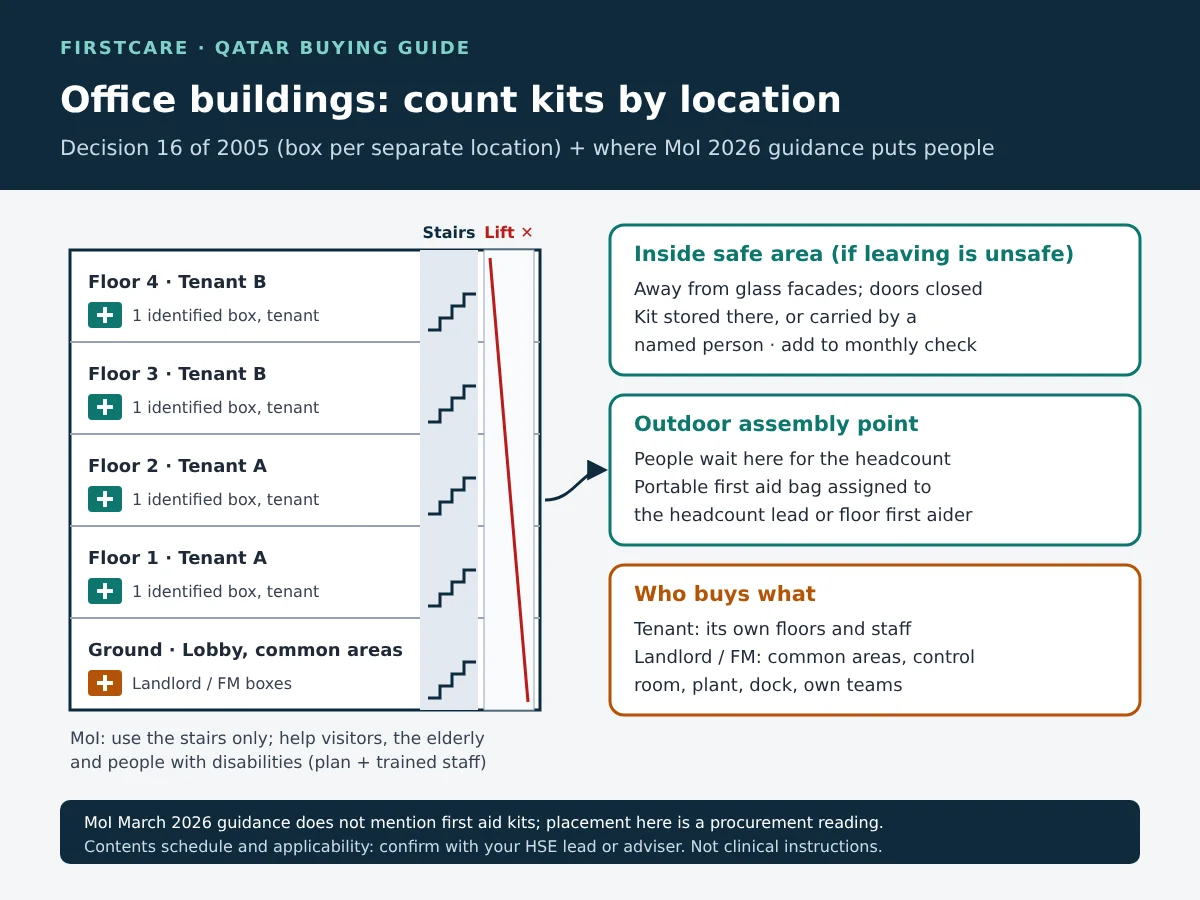
Count first aid kits by location, not by building. Ministerial Decision No. 16 of 2005 asks employers for a first aid box stocked to an attached schedule and deals with work locations that are separate from one another, so each tenancy, floor or wing that works on its own needs its own box. The Ministry of Interior's March 2026 workplace guidance does not mention first aid, but it decides where people will be in an emergency: on the stairs (never the lifts), at a designated assembly point outside the building, or in the nearest safe area inside, away from glass. A practical office plan therefore lists one identified box per occupied floor or tenancy, checks that the people who gather in an inside safe area or at the assembly point can reach a kit, and asks the building's safety team whether any equipment is needed to help someone who cannot use stairs.
What the Qatar sources say, and what they do not
Ministerial Decision No. 16 of 2005 on medical care for workers is the base text. In the unofficial reproduction we read, Article 2 asks the employer to provide a first aid box with the contents and quantities set out in an attached schedule, and addresses establishments whose work locations are separate from one another. Article 3 adds a full-time nurse above 100 workers, and a clinic with a doctor, a nurse and a first aid room above 500. The schedule itself was not in the copy we could read, so ask your HSE or medical lead for the version they apply. Whether a rented office floor is a "separate location" for your company is a question for your adviser, not for a supplier.
In March 2026 the Ministry of Interior published workplace guidance for security alerts and a precautionary evacuation manual for workplaces. As reported by QNA and the Qatar press, it asks staff to know the exits, routes and assembly points in advance, note where safety equipment and fire extinguishers are, use the stairs and not the lifts, help colleagues and visitors, especially the elderly and people with disabilities, stay at the outdoor assembly point until the headcount is complete, and, when leaving is not possible, move to the nearest safe place inside the building away from glass facades. Neither the QNA item nor the press reports of the manual mention first aid kits. The planning points below are our procurement reading, not an MoI requirement.
One identified box per floor or tenancy
Start from the floor plan and the occupancy list. A tower with one company on six floors and a commercial complex with forty tenants are both "one building", but the second has forty employers, each with its own Decision 16 duty for its own staff. The landlord or facility manager usually covers common areas, the security control room and its own maintenance and cleaning teams; each tenant covers its own premises. Write that split down before anyone orders, so the same corridor is not counted twice and the loading dock is not counted at all.
Qatar University's first aid procedure is one published example of the per-floor approach: it asks for first aid kits in all premises, at least one per floor plus vehicles, kept in identified locations with a first aid sign and inspected monthly by a nominated first aider against a checklist kept with the kit. It binds the university only, but it shows the level of detail a client or landlord may expect.
On smaller screens, scroll sideways within this table. Keyboard: focus the table, then use the left and right arrow keys.
| Location | Who usually provides it | What to put in the quotation |
|---|---|---|
| Each occupied office floor or wing of one employer | That employer (tenant) | One box per location, sized to the people on that floor per shift; contents to the schedule your HSE lead applies |
| Reception and visitor desk | Tenant or landlord, by agreement | Box location, and whether visitors and contractors are counted in the size |
| Security or building control room | Landlord or facility manager | Box plus any equipment the building emergency plan assigns to the control room |
| Plant rooms, loading dock, car park, roof works | Landlord or the contractor working there | Separate boxes if these teams work apart from the offices; eyewash only where the risk assessment calls for it |
| Inside safe area named in the emergency plan | Whoever owns the emergency plan | Whether a kit is kept there or carried there by a named person |
| Outdoor assembly point | Whoever owns the emergency plan | A portable bag or box assigned to the person who takes the headcount |
Kits where people will actually be during an alert
Wall-mounted boxes are placed for normal working hours. The MoI guidance moves people to two other places: an assembly point outside the building, where they wait for a headcount, and, when leaving is not possible, a safe area inside the building away from glass. If those places are far from any kit, the plan has a gap that an ordinary floor count will not show.
Two simple fixes are common. Either name a person, such as the floor's first aider or the headcount lead, who takes a portable first aid bag on the way out, or keep a sealed box in the inside safe area and add it to the monthly inspection list. Both are equipment decisions; what the first aider does with the contents is covered by their training, not by this guide.
- Mark the outdoor assembly point and each inside safe area on the floor plan you send with the enquiry.
- For each, record whether a kit is stored there or carried there, and by whom.
- Ask for portable bags with a carry strap if kits will leave the wall; a wall box is awkward on stairs.
- Add carried bags to the monthly check, because they are the ones most likely to be left in a cupboard after a drill.
Helping someone who cannot use the stairs
The MoI guidance says to use the stairs, not the lifts, and to help the elderly and people with disabilities. How that help is given is part of the building's emergency plan and the training of the people assigned to it. A supplier cannot decide it, and this guide does not describe how to move a person.
If the plan calls for equipment, list it as a separate line. Our catalogue includes an aluminium folding stretcher chair (FC-FSC-007) that converts between stretcher and chair configurations. Its rated load and any stair-descent rating are not in our published product data, so ask for the model documents and confirm in writing that the model suits your stairwells, landings and the loads in your plan before ordering. Count how many units you need per stair core, where they will be stored, and who is trained to use them.
Send a quote request the building can check
A good enquiry for an office or commercial building lets the facility manager tick each item off against a location when the delivery arrives. Keep the boxes for different tenants or cost centres on separate lines, even when one person sends the request.
- Building name, area (for example West Bay, Lusail or Msheireb) and the full delivery address.
- Floor-by-floor list: occupied floors, tenancy or cost centre, and people present per shift.
- The contents schedule your HSE or medical lead applies, or the client or landlord checklist.
- Common-area locations the landlord covers, kept apart from tenant locations.
- Assembly point and inside safe area kits: stored or carried, bag or box.
- Any stretcher chair or transport equipment the emergency plan lists, with the documents you need.
- Expiry dates and minimum remaining shelf life on delivery; refill packs for the monthly checks.
Common questions
Does the Ministry of Interior's 2026 evacuation guidance require first aid kits?
No. As reported by QNA and the Qatar press, the March 2026 workplace guidance and evacuation manual cover exits, routes, assembly points, stairs instead of lifts, headcounts and sheltering inside away from glass. They do not mention first aid kits. The kit duty comes from Ministerial Decision No. 16 of 2005 and from client or landlord requirements; the MoI guidance only tells you where people will be.
How many first aid boxes does a Qatar office floor need?
Decision 16 of 2005 asks for a box stocked to its attached schedule and deals with separate work locations, but the copy we read does not give a per-floor number. Many procedures use at least one identified box per floor; Qatar University's procedure, for example, asks for at least one per floor. Size each box to the people on that floor per shift and confirm the schedule with your HSE lead.
In a shared office tower, does the landlord or the tenant buy the kits?
Usually both, for different areas. Each tenant equips its own premises for its own staff; the landlord or facility manager equips common areas, the security control room and its own maintenance teams. Agree the split in writing so reception, the loading dock and the assembly point are not missed.
Can you supply a stair chair for evacuating people who cannot use the stairs?
Our catalogue lists a folding stretcher chair (FC-FSC-007) that converts between stretcher and chair. Its rated load and stair rating are not in our published data, so request the model documents and confirm suitability for your stairwells in writing. Who uses it, and how, belongs in your building's emergency plan and training.
Related guides and equipment
More Qatar buying guides
- QAPCO Contractor First Aid in Mesaieed: First Aiders, Boxes and the Monthly Box Check
- Football Club and Training Ground First Aid in Qatar: What the QSL Licensing Rules Ask For
- Laboratory Eyewash and Safety Showers in Qatar: A Buyer's Checklist
- University Campus First Aid in Qatar: Kits per Floor, Monthly Checks and a 31-Item Checklist
- Hotel First Aid in Qatar: What the Qatar Tourism Classification Manuals Ask For
- Lusail Contractor First Aid Boxes: Monthly Inspection, Contents and Records
- First Aid Room Equipment for Qatar Workplaces: Furniture and Supplies Checklist
- Worker Accommodation First Aid in Qatar: Kits, Medical Room and Bus Supplies
- First Aid Supplies for QatarEnergy Contracts: A Contractor's Checklist
- Heat-Stress Supplies for Outdoor Work in Qatar: What to Buy Before Summer
- Workplace Stretchers in Qatar: Folding, Scoop, Basket or Chair?
Prepared with AI assistance. Procurement information, not clinical instructions or an approval certificate. Requirements depend on the applicable authority and your workplace. Sources, corrections and editorial policy.