
FirstCare buying journal
Workplace Stretchers in Qatar: Folding, Scoop, Basket or Chair?
Compare folding, scoop, basket and chair stretchers for Qatar workplaces. Match the route, storage, team and model documents before requesting a quote.
By FirstCare First Aid · Published · Updated
The short answer
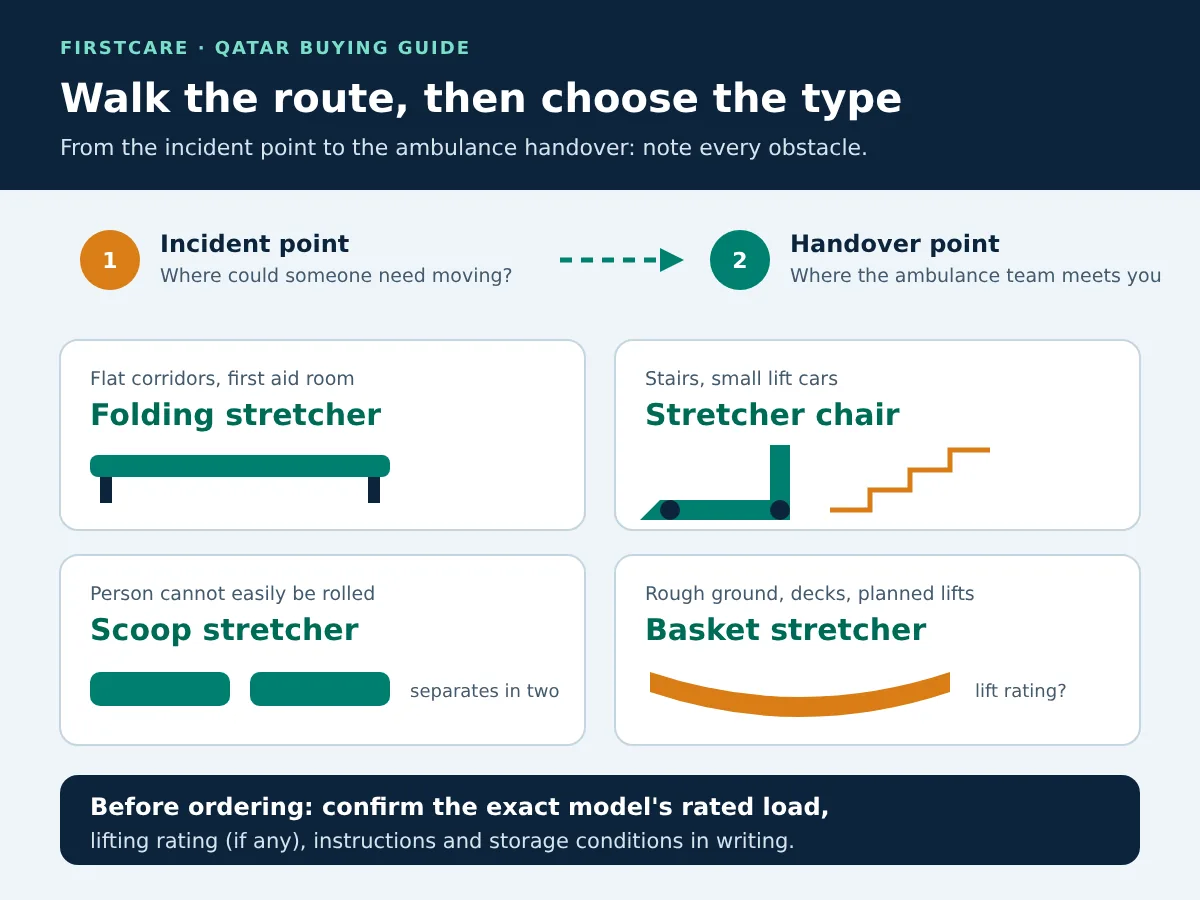
Choose a workplace stretcher by the route a person would have to be moved along, then by who will use it. Folding stretchers suit flat routes and compact storage; scoop stretchers separate into two halves; basket stretchers give a rigid, enclosed carrying shell for rough ground or a planned rescue; and a stretcher chair suits stairs and tight lifts. The Qatar first aid decision we reviewed does not name a stretcher type, so your risk assessment and emergency plan should decide, and the supplier should document the exact model’s rated load and instructions.
What the Qatar first aid decision says, and what it leaves to you
Ministerial Decision No. 16 of 2005 on medical care for workers in establishments sets out first aid boxes, trained first aiders and medical staffing. In the copy we read, Article 2 requires a stocked first aid box with the medicines, tools and quantities in an attached schedule, and boxes for an employer’s separate work locations. Article 3 adds a full-time nurse where an establishment has more than 100 workers, and a clinic with at least one doctor and one nurse plus a room for first aid where it has more than 500.
None of the seven articles in that copy mentions a stretcher. We did not have the attached contents schedule, so we cannot say whether it lists one. Treat the stretcher decision as part of your site’s emergency planning and confirm with your responsible Qatar HSE or medical lead whether any client, contract or site rule adds a specific requirement.
The copy we used is reproduced by UN ESCWA and states that it is not an official version. The official Arabic text is on Qatar’s Al Meezan legal portal. This summary is not legal advice.
Walk the route before you choose the type
It is easy to buy for the casualty and forget the building. Walk from each likely incident point to the place where your team would hand over to the ambulance service. Note stairs, landings, lift car size, door widths, ramps, loose ground, ladders and any point where the stretcher would have to be raised or lowered.
Then match the route to a type. This table is an original planning aid for a quote discussion. It is not a clinical selection guide: how a person is moved should follow the training of the responders and the advice of the emergency services.
On smaller screens, scroll sideways within this table. Keyboard: focus the table, then use the left and right arrow keys.
| Route or site feature | Stretcher type to discuss | Question for the supplier |
|---|---|---|
| Flat corridors, a first aid room or a clinic | Folding stretcher | What is the folded size and rated load of the exact model? |
| Narrow stairs and small lift cars | Stretcher chair | What are the chair and stretcher dimensions, and is the model intended for stair use? |
| A person who cannot easily be rolled onto a stretcher | Scoop stretcher | How does the model separate and lock, and what training does the manufacturer specify? |
| Rough ground, yards, decks or a planned rescue | Basket stretcher | Is the model rated for lifting, and with which bridle, straps and attachment points? |
| Pool decks and water edges | Spine board | Is the board buoyant and what strapping comes with it? |
The stretcher types in the FirstCare catalogue
FirstCare lists two folding stretchers (FC-FS-001 and FC-FSP-017), two scoop stretchers (FC-SS-003 and FC-SSER-019), three basket stretchers (FC-EBS-002, FC-PBS-008 and FC-EBSR-018), a folding stretcher chair (FC-FSC-007) and two spine boards. The catalogue gives each model’s weight and dimensions, for example 8 kg and 210 × 55 × 13 cm for the standard folding stretcher, 9 kg and 166–210 × 44 × 7 cm for the professional scoop stretcher, and 10 kg and 190 × 55 × 82 cm for the stretcher chair.
Only the standard folding stretcher lists a weight capacity (159 kg). For every other model, ask for the rated load in the written quotation and do not assume one model’s figure applies to another. Certification and warranty are confirmed per model on request; the catalogue does not claim an approval for any of them.
Weight matters more than it looks. A 15–16 kg basket stretcher has to be carried to the scene before anyone is placed in it, so check who will carry it and how far.
Basket stretchers, lifting and rescue plans
In industrial areas such as Ras Laffan, Mesaieed and Dukhan, and at ports, yards and on vessels, a casualty may need to be moved over uneven ground or lifted, which is where basket stretchers come into the discussion. A basket stretcher is only one part of a rescue arrangement. Ireland’s Health and Safety Authority code for confined spaces, used here as international background, says rescue arrangements must be in place before anyone enters, retrieval must be planned, and rescue equipment must be maintained, inspected and available wherever the work takes place.
The US OSHA rule for marine terminals and longshoring gives a concrete example of what a written stretcher requirement can look like. It calls for at least one Stokes basket stretcher or equivalent for each vessel being worked, at least four sets of patient restraints, lifting bridles able to lift 454 kg with a safety factor of five, foot plates for vertical lifts, and stretchers mounted and protected from the elements. That is a US rule, not a Qatar requirement, but it shows the details worth asking a supplier about.
If your plan includes lifting a stretcher by rope, crane or davit, confirm in writing that the exact model is rated for it and which lifting accessories go with it. Ordinary first aid stretchers should not be assumed to be suitable for rescue lifts, offshore use or explosive atmospheres unless the manufacturer’s documents say so.
Storage and inspection on Qatar sites
Decide where each stretcher lives and who checks it. A stretcher kept in a container yard or on a rooftop plant area can be exposed to direct sun, dust and high temperatures, so ask the supplier for the manufacturer’s storage conditions and whether a wall mount or cover is available. Keep the stretcher where the route walk showed it is needed, not wherever there is space.
Add the stretcher to the same inspection routine as your first aid boxes. Check that straps and buckles work, fabric and shell are not cracked or torn, locking mechanisms engage, and the manufacturer’s instructions are kept with it. Take a damaged stretcher out of use until it is repaired or replaced.
- Location and station identifier for each stretcher.
- Model, serial or batch number where provided, and the manufacturer’s instructions.
- Who inspects it, how often, and where the record is kept.
- Accessories that must stay with it: straps, head immobiliser, bridle or cover.
What to send with a Qatar stretcher enquiry
A clear enquiry gets a comparable quote. FirstCare’s contact team is based in the UAE; delivery to Qatar, lead time and the documents supplied are confirmed in the written quotation, not assumed from this page.
- Site location (for example Doha, Lusail, Al Wakrah, Al Khor, Ras Laffan, Mesaieed or Dukhan) and the receiving contact.
- Your route notes: stairs, lift car size, door widths, ground conditions and any planned lift.
- The stretcher types and quantity per station, plus accessories such as straps or a head immobiliser.
- The rated load you need and any lifting rating, so the supplier can confirm the exact model.
- Documents you need: user instructions, the model’s technical data and any declaration or test certificate your client requires.
Common questions
Does Qatar law require a stretcher in every workplace?
The seven articles of Decision No. 16 of 2005 that we reviewed do not mention a stretcher, and we did not have its attached contents schedule. Ask your responsible HSE or medical lead whether a site, client or contract rule requires one.
Can any basket stretcher be lifted by rope or crane?
No. Lift a stretcher only if the manufacturer rates that exact model for lifting, with the specified bridle and accessories, and only as part of a planned rescue by trained people.
Which stretcher works best on stairs?
A stretcher chair is usually discussed for stairs and small lifts because it can be used seated. Check the model’s dimensions against your stairwell and lift car before ordering.
Do you supply stretchers to Qatar?
Send your site location and requirements through the contact page. The UAE-based team confirms the exact model, documents, delivery and lead time for Qatar in the written quotation.
Related guides and equipment
More Qatar buying guides
- QAPCO Contractor First Aid in Mesaieed: First Aiders, Boxes and the Monthly Box Check
- Football Club and Training Ground First Aid in Qatar: What the QSL Licensing Rules Ask For
- Office and Commercial Building First Aid Kits in Qatar: Floor-by-Floor Placement
- Laboratory Eyewash and Safety Showers in Qatar: A Buyer's Checklist
- University Campus First Aid in Qatar: Kits per Floor, Monthly Checks and a 31-Item Checklist
- Hotel First Aid in Qatar: What the Qatar Tourism Classification Manuals Ask For
- Lusail Contractor First Aid Boxes: Monthly Inspection, Contents and Records
- First Aid Room Equipment for Qatar Workplaces: Furniture and Supplies Checklist
- Worker Accommodation First Aid in Qatar: Kits, Medical Room and Bus Supplies
- First Aid Supplies for QatarEnergy Contracts: A Contractor's Checklist
- Heat-Stress Supplies for Outdoor Work in Qatar: What to Buy Before Summer
- Qatar First Aid Kit Quotes: Check the Contents Schedule
Prepared with AI assistance. Procurement information, not clinical instructions or an approval certificate. Requirements depend on the applicable authority and your workplace. Sources, corrections and editorial policy.