
FirstCare buying journal
Travel First Aid Kit UAE: What to Pack, Buy and Carry On
Travel first aid kit guide for UAE and GCC travellers: what to pack, ready-made vs compact DIY kits, airport liquid and scissors rules, and medicines.
By FirstCare First Aid · Published · Updated
The short answer
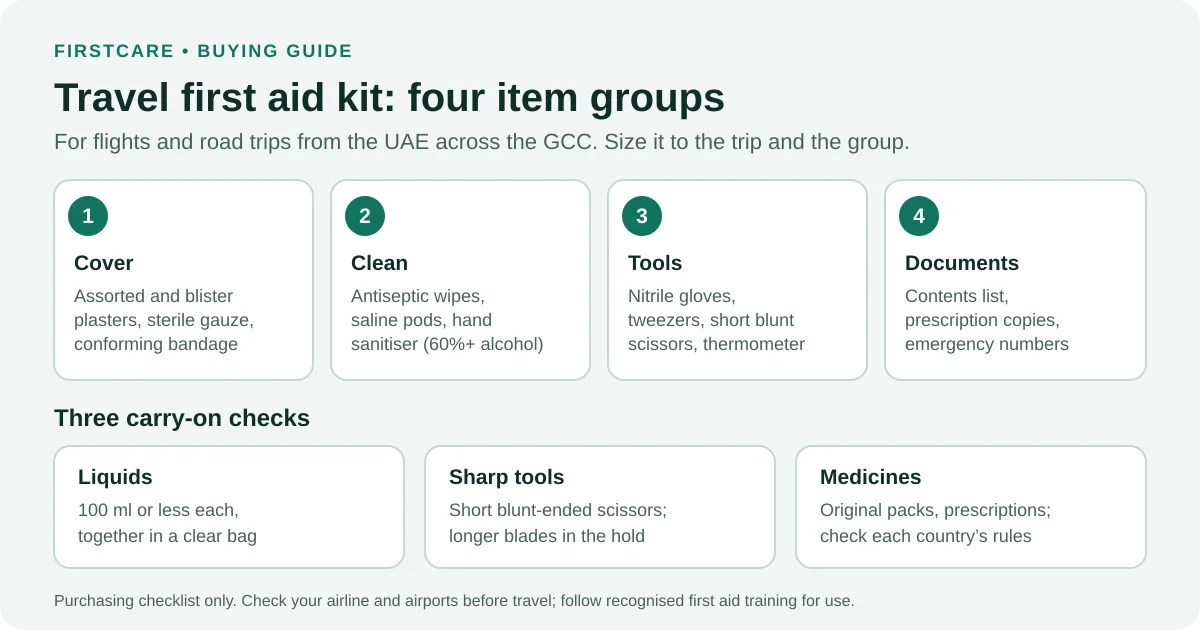
A travel first aid kit for UAE and GCC travellers should be small, sealed and water-resistant, holding assorted plasters, sterile gauze and a conforming bandage, tape, antiseptic wipes, gloves, tweezers, blunt-ended scissors, hand sanitiser and copies of prescriptions. Keep it in your cabin bag, liquids at 100 ml or less, and check medicine rules for every country on your route.
What should be in a travel first aid kit for UAE and GCC trips?
A travel first aid kit should cover the minor cuts, blisters and scrapes that happen on holiday, plus the tools and documents you would struggle to find in an unfamiliar city. This travel first aid kit UAE checklist is built for residents flying out of Dubai, Abu Dhabi or Sharjah, driving to Oman, or visiting family across the GCC.
The CDC Yellow Book 2026 recommends that every traveller carry a basic personal kit whose contents depend on their health history and the type of trip, kept in a durable, water-resistant container that stays within reach. The American Red Cross lists assorted adhesive bandages and adhesive first aid tape as the basics and advises carrying copies of all prescriptions. We found no UAE or GCC rule that sets the contents of a personal travel kit, so treat the table as a shopping list and adjust quantities to trip length and the number of travellers.
On smaller screens, scroll sideways within this table. Keyboard: focus the table, then use the left and right arrow keys.
| Group | Typical items | What to check when buying |
|---|---|---|
| Cover | Assorted plasters including blister plasters, sterile gauze pads, a non-adherent dressing, one conforming roller bandage | Each sterile item individually wrapped; sizes printed on the pack |
| Clean | Antiseptic wipes, single-use sterile saline pods, hand sanitiser | Sealed sachets rather than bottles; sanitiser with at least 60% alcohol; each liquid 100 ml or less |
| Tools | Disposable nitrile gloves, tweezers, blunt-ended scissors with short blades, safety pins, a digital thermometer | Blade length stated by the maker; latex-free gloves if anyone has a latex allergy |
| Documents | Contents list, copies of prescriptions, emergency numbers for each country, travel insurance assistance number | Kept in a zip bag inside the kit and saved on your phone |
Should you buy a ready-made travel kit or pack a compact one yourself?
Buy a ready-made travel kit if you want a sealed, organised pouch in one purchase; pack your own if you already keep a well-stocked home kit and only need a smaller set for the trip. Many families do both: a small ready-made pouch topped up from the home kit.
UAE pharmacy and marketplace listings describe travel kits by piece count, often 60 to 180 pieces. As with home kits, a high count is usually made up of small plasters, so compare the contents list item by item. Check whether the pouch closes fully, whether the scissors and liquids are cabin-friendly, and whether the earliest expiry date is printed on the outside.
On smaller screens, scroll sideways within this table. Keyboard: focus the table, then use the left and right arrow keys.
| Option | Strengths | Watch for |
|---|---|---|
| Ready-made travel pouch | Organised and compact; one purchase; often water-resistant | Piece counts inflated by small plasters; scissors or liquids that are not cabin-friendly; no gloves |
| Compact kit packed from your home kit | Uses items you already trust; quantities match your trip | Home kit left short when you return; loose items without a contents list |
| Small empty case plus refills | Durable case reused trip after trip; contents chosen item by item | Needs a written contents list and a pre-trip check |
Can you take a first aid kit in your cabin bag?
Yes, in most cases a small first aid kit can travel in your cabin bag, provided the liquids and sharp tools meet airport security limits. Keep each liquid, gel or cream to 100 ml or less and pack them together in a clear, resealable bag, unless they qualify for a medical exemption.
flydubai states on its forbidden and restricted items page that liquids, gels or pastes over 100 ml for medical or dietary needs may be carried if you can show proof, such as a doctor’s prescription, at security. Gulf News, reporting Dubai Airports rules, lists scissors with blades longer than 6 cm among items not allowed in cabin baggage. Rules differ by airport and airline and change over time, so check both your airline and your departure and transit airports before you fly, and put any larger scissors or tools in checked baggage.
- Liquids: 100 ml or less each, together in one clear resealable bag.
- Larger medical liquids: carry the prescription and tell security.
- Scissors: blunt-ended with short blades in the cabin; anything longer in checked baggage.
- Medicines: in the cabin bag, not checked baggage, in case luggage is delayed.
Can you carry medicines in a travel first aid kit?
Carry personal medicines separately from the first aid supplies, in their original packaging with a copy of the prescription, and check the rules of every country on your route before you travel. The CDC Yellow Book advises taking health kits on board as carry-on luggage and keeping medicines and medical supplies in their original containers.
For the UAE, the Ministry of Health and Prevention (MOHAP) runs an e-service, Issue of Permit to Import Medicines for Personal Use, for travellers bringing certain controlled or semi-controlled medicines into the country. Other GCC countries have their own rules, and the destination’s embassy or health ministry is the authority to ask. This guide does not recommend medicines or doses; ask your doctor or pharmacist which products suit your trip and your family.
How do heat and car journeys affect a travel kit?
Heat shortens the useful life of some first aid items, so keep a travel kit out of direct sun and avoid leaving it in a parked car during GCC summers. Adhesives soften, instant cold packs can swell or leak, and liquids and medicines may have storage limits printed on the pack.
On road trips to Oman or Saudi Arabia, carry the kit inside the cabin rather than the boot and take it with you at rest stops. Our guide to first aid kit storage in UAE vehicles explains how to check manufacturer storage ranges, and the instant cold pack buying guide covers packs that are often added to sport and beach trips.
What extras suit children, sport, desert and Umrah trips?
Add a few items for the people and activities on your trip rather than buying the largest kit. The extras below are buying suggestions only; for anything medical, ask a doctor or pharmacist, and the CDC Yellow Book describes a larger, extended kit for groups travelling to remote areas.
On smaller screens, scroll sideways within this table. Keyboard: focus the table, then use the left and right arrow keys.
| Trip type | Items travellers often add | Buying check |
|---|---|---|
| Travelling with young children | Children’s-size plasters, a thermometer suited to the child’s age, extra wipes | Child-resistant pouch; thermometer instructions for age |
| Beach, hiking and sport | Extra blister plasters, an extra conforming bandage, instant cold pack for the car or day bag | Cold pack storage range; bandage width printed on the pack |
| Desert camping and remote drives | Larger sterile dressings, extra gloves, a foil blanket, a printed list of emergency numbers | Water-resistant case; contents for the number of people in the group |
| Umrah and long walking days | Blister plasters, tape, hand sanitiser, a spare contents list | Compact pouch that fits a small day bag |
How should you check a travel kit before each trip?
Check the kit a few days before every trip and again when you unpack: replace anything used, damaged or past its expiry date, and make sure every sterile item is still sealed. Write the earliest expiry date on the contents list so the next check is quick.
A travel kit is a personal kit. If your trip is for work, such as site visits or a mobile team, your employer’s first aid needs assessment and any emirate or free-zone rules apply, and a workplace kit such as our 10 person first aid kit is the usual starting point.
- Restock used plasters, dressings and gloves.
- Discard sterile packs with torn, wet or opened wrappers.
- Check liquids are 100 ml or less and in the clear bag.
- Update emergency numbers and prescription copies for the destination.
- Replace swollen, leaking or expired instant cold packs.
Common questions
What should be in a basic travel first aid kit?
Assorted and blister plasters, sterile gauze pads, a conforming bandage, tape, antiseptic wipes, hand sanitiser, disposable gloves, tweezers, blunt-ended scissors, a thermometer, a contents list and copies of prescriptions. Adjust quantities to the trip length and number of travellers.
Can I take a first aid kit on a plane from the UAE?
Usually yes, in the cabin bag, if each liquid is 100 ml or less in a clear resealable bag and any scissors have short blades. Dubai Airports rules, as reported by Gulf News, exclude scissors with blades longer than 6 cm from cabin baggage. Check your airline and every airport on your route.
Can I bring medicines into the UAE in my travel kit?
Carry medicines in original packs with a copy of the prescription. Certain controlled and semi-controlled medicines need a MOHAP permit for personal use; check the MOHAP e-service before you travel, and the rules of other countries on your route.
Is a ready-made travel first aid kit worth buying?
It is a convenient start if the contents list, not just the piece count, matches your trip. Check that the pouch is water-resistant, the liquids and scissors are cabin-friendly, and top it up with gloves or blister plasters if they are missing.
How often should I check my travel first aid kit?
Before every trip and when you unpack. Replace used, damaged or expired items, make sure sterile packs are sealed, and update emergency numbers for your next destination.
Related guides and equipment
Prepared with AI assistance. Procurement information, not clinical instructions or an approval certificate. Requirements depend on the applicable authority and your workplace. Sources, corrections and editorial policy.