
FirstCare buying journal
Instant Cold Pack UAE: Buying and Storage Guide
Instant cold pack UAE guide: instant vs gel packs, kit quantities, car storage in heat, expiry dates and label checks for homes, cars, sport and schools.
By FirstCare First Aid · Published · Updated
The short answer
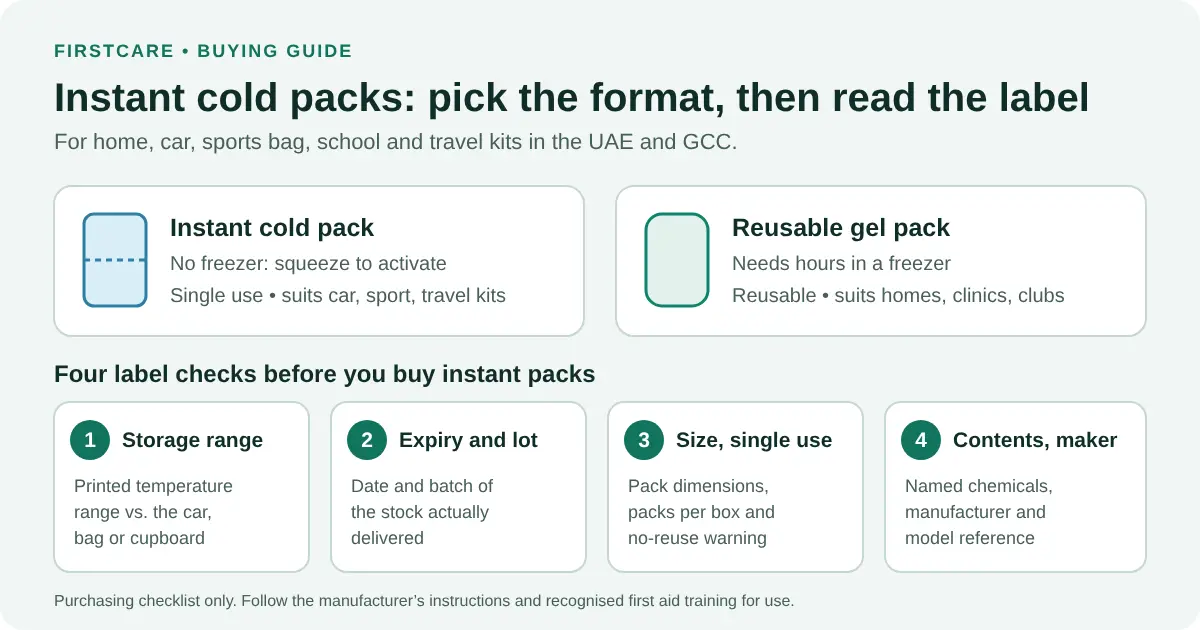
An instant cold pack is a single-use, sealed bag that turns cold when you squeeze it, so it needs no freezer. For UAE and GCC buyers, choose one by checking the printed storage temperature range, expiry date, pack size and single-use warning against where it will be kept: a home cupboard, car, sports bag, classroom or travel case.
What is an instant cold pack, and how is it different from a gel pack?
An instant cold pack is a sealed plastic bag holding chemicals and water in separate compartments; breaking the inner pouch starts a reaction that makes the pack cold. A reusable gel pack, by contrast, only gets cold after time in a freezer and can be used again. That difference decides where each one is practical when you buy an instant cold pack in the UAE or elsewhere in the GCC.
The US Food and Drug Administration describes the device type in 21 CFR 890.5710 as “a sealed plastic bag incorporating chemicals that, upon activation, provides hot or cold therapy for body surfaces” and places it in Class I (general controls). This US rule is useful because it names the product category precisely; it does not decide whether a product may be sold in the UAE, Saudi Arabia, Qatar, Oman, Kuwait or Bahrain. For GCC buyers, ask the supplier which local registration or listing applies to the exact model offered.
The table below compares the three options buyers usually weigh. It is a purchasing comparison, not advice on when or how to apply cold to an injury; follow the product’s own instructions and the guidance taught on a recognised first aid course.
On smaller screens, scroll sideways within this table. Keyboard: focus the table, then use the left and right arrow keys.
| Option | Preparation before use | Reuse | Where it usually fits | Main buying check |
|---|---|---|---|---|
| Instant cold pack | None; activated by squeezing or striking the pack | Single use | Car kits, sports bags, school trip bags, travel kits, workplace boxes | Storage temperature range, expiry date and single-use wording on the label |
| Reusable gel pack | Hours in a freezer | Reusable until damaged | Homes, clinics, staff rooms and sports clubs with a freezer | Freezer access, a cover or sleeve, and whether the pack is labelled for freezer and hot use |
| Ice in a bag or ice-maker | Ice must be available on site | Not applicable | Kitchens, pools and venues that already make ice | Clean bags and a reliable ice supply; not portable for kits |
How many instant cold packs should a first aid kit hold?
There is no single GCC-wide number for cold packs in a home, car or sports kit; the right quantity follows the activities and the number of people the kit serves. For workplaces, the contents should come from the site’s first aid needs or risk assessment rather than a retail kit label.
Two widely used references show how this works. The US standard ANSI/ISEA Z308.1-2021 sets minimum fills for workplace kits; its Table 1, as reproduced by Sacramento State’s Environmental Health and Safety office, lists one cold pack in a Class A kit and two in a Class B kit. In the UK, the Health and Safety Executive states that buying kits that comply with BS 8599-1 is not a regulatory requirement and that, whichever kit is used, “the contents should reflect the outcome of the first-aid needs assessment”.
In the UAE, Abu Dhabi’s ADOSH-SF Code of Practice 4.0 (version 4.0, 15 July 2024) links first aid resources to assessed risks and sets minimum kit contents in Appendix 1, with stricter applicable rules taking precedence. Use these sources for what they cover: a US voluntary standard, UK regulator guidance and an Abu Dhabi workplace code. None of them sets a cold pack quantity for a family car or a youth football bag.
For homes and personal kits, a practical buying approach is to decide how many people and activities the kit covers and how often you can restock it. A sports team or school trip that may need several packs in one session usually buys loose packs in a box rather than relying on the single pack inside a small kit.
Can you keep instant cold packs in a car in UAE summer?
Only if the conditions in that car stay within the storage range printed by the pack’s manufacturer, so read the label before choosing a car kit. Instant packs need no freezer, which is why they appear in car and travel kits, but “no refrigeration needed” is not the same as “safe in any heat”.
Manufacturers state storage conditions per product. One example in the FDA’s AccessGUDID database, a Medline hot or cold disposable pack (device identifier 10888277353596), records the special storage condition “protect from freezing, avoid excessive heat”. Other brands print a numeric range on the box. FirstCare has not tested cold packs in parked vehicles and does not publish a cabin temperature figure; compare the label with where the kit will actually sit, such as the boot, glove box or a shaded cabin compartment, and for how long.
If a car pack looks swollen, leaking, hardened or damaged, treat it as unusable and replace it. Our separate guide to first aid kit storage in UAE vehicles covers the wider kit, including plasters, dressings and other items with their own storage instructions.
Do instant cold packs expire?
Yes, most instant cold packs carry a printed expiry or use-by date, and that date is the one to rely on. Shelf life differs between manufacturers and models, so do not assume a period from another brand or from an online article.
When you buy a box, ask for the expiry date and lot number of the stock being delivered, not the shelf life from a catalogue. Record the earliest date in the box so the whole batch is replaced in time. Our first aid kit expiry dates guide explains how to request remaining shelf life at delivery and how to log mixed dates inside one kit.
What should an instant cold pack label tell you before you buy?
Before ordering, check that the outer box or individual pack states the following. If an online listing does not show it, ask for a clear photo of the label or the manufacturer’s instructions for use.
- Manufacturer or brand, product name and model or reference number.
- Pack dimensions and how many packs are in each box, so two quotes compare the same quantity.
- Single-use statement and any warning against refreezing or reusing the pack.
- Storage conditions, ideally as a temperature range, and any “do not freeze” or “avoid excessive heat” wording.
- Expiry or use-by date and lot or batch number on each pack or the box.
- Contents as named by the manufacturer, for example ammonium nitrate, calcium ammonium nitrate or urea with water, and where to find the safety data sheet.
- Warnings and instructions for use from the manufacturer, for example about protecting the skin or use on infants; follow these rather than general advice.
- Any registration, listing or certification claim, with the authority and product reference it applies to.
Which type of cold pack suits homes, cars, sport, schools and travel?
Match the format to where the pack will wait and who will use it. The table summarises common buying choices; it does not replace a workplace risk assessment or a school’s or club’s own medical policy.
On smaller screens, scroll sideways within this table. Keyboard: focus the table, then use the left and right arrow keys.
| Setting | Usual choice | What to check when buying |
|---|---|---|
| Home | Reusable gel pack in the freezer, plus one or two instant packs in the home kit | Gel pack cover; instant pack expiry so the kit pack is not forgotten |
| Car | Instant cold packs inside the car kit | Printed storage range against the car compartment; replace damaged or expired packs |
| Sports bag or club | Box of instant packs for training and matches; gel packs where a freezer is available | Quantity per session, pack size and restocking after each event |
| School or nursery | Instant packs in trip bags; follow the school’s medical policy for the clinic | Single-use labelling, expiry log and who restocks trip bags |
| Travel kit | Small instant packs | Pack size and weight; check the airline’s current rules before flying with chemical packs |
| Small business | Instant packs within the first aid box contents set by the needs assessment | Quantity in the agreed contents list and refill timing |
How should you compare quotes for boxes of instant cold packs?
Compare the cost per pack of the same size and specification, then the remaining shelf life at delivery. A cheaper box with smaller packs or a shorter remaining date is not the same offer.
Ask each supplier to state the brand and reference, pack size, packs per box, expiry date of the stock to be delivered, storage conditions and any registration claim with its reference. FirstCare’s catalogue lists an instant cold pack sold as a box of 24; confirm the current model, label details, price and delivery in a written quotation, as this article makes no stock or price commitment.
Common questions
Are instant cold packs reusable?
No. Instant cold packs are single-use: the chemical reaction cannot be restarted once the inner pouch is broken. Follow the manufacturer’s warning about not refreezing or reusing the pack, and buy reusable gel packs if you need a pack that can be used again.
Can I leave instant cold packs in my car in the UAE?
Only within the storage conditions printed on the pack. Some manufacturers state a temperature range and others say “avoid excessive heat”. Check the label against the car compartment and replace any pack that is swollen, leaking, damaged or past its date.
How long do instant cold packs last before expiry?
It depends on the manufacturer and model, so use the expiry date printed on the pack or box. When buying in bulk, ask for the expiry date and lot number of the actual stock being delivered.
Instant cold pack or gel pack: which should I buy?
Buy instant packs for kits without a freezer, such as car, sports, school trip and travel kits. Reusable gel packs suit homes, clinics and clubs with freezer access. Many buyers keep both.
How many cold packs should a first aid kit have?
No single GCC rule sets a number for home or car kits. As a workplace reference, ANSI/ISEA Z308.1-2021 lists one cold pack for Class A and two for Class B kits, while UK HSE guidance says contents should follow the first aid needs assessment.
Related guides and equipment
Prepared with AI assistance. Procurement information, not clinical instructions or an approval certificate. Requirements depend on the applicable authority and your workplace. Sources, corrections and editorial policy.