
FirstCare buying journal
Home First Aid Kit Checklist UAE: What to Buy and Keep
Home first aid kit checklist for UAE homes: what to stock, ready-made vs DIY kits, where to store it in the heat, how often to check it, and family extras.
By FirstCare First Aid · Published · Updated
The short answer
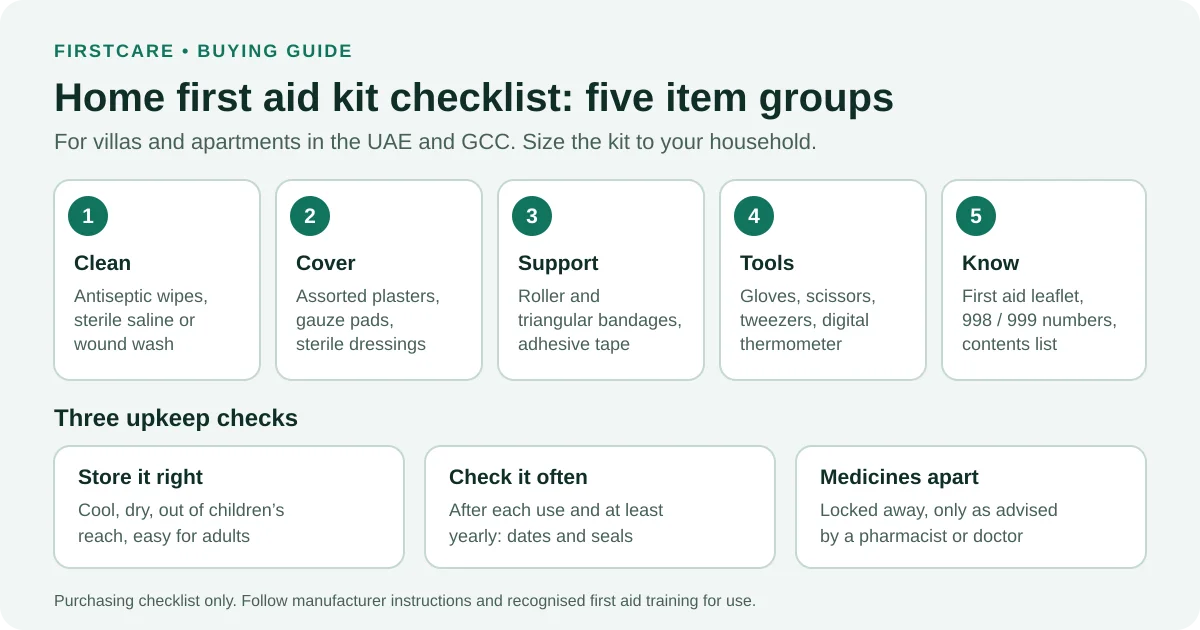
A home first aid kit checklist for the UAE covers five groups: wound cleaning wipes or saline, assorted plasters and sterile dressings, bandages and tape, tools such as gloves, scissors, tweezers and a thermometer, and a first aid leaflet with emergency numbers. Keep it cool, dry and out of children’s reach, and check it after every use.
What should be in a home first aid kit in the UAE?
A home first aid kit should hold supplies to clean, cover and support minor injuries, a few basic tools and written guidance. We found no UAE federal or emirate rule that sets the contents of a household kit, so this home first aid kit checklist draws on published public-health lists and adapts them to how UAE and GCC families live.
Emirates Health Services includes a first aid kit in its recommended household emergency supply kit and suggests a separate car kit. The most widely reproduced itemised list comes from the American Red Cross, which recommends that a kit for a family of four include, among other items, two absorbent compress dressings (5 × 9 inches), a 4-inch roller bandage, sterile gauze pads in 3 × 3 and 4 × 4 inch sizes, a non-mercury, non-glass oral thermometer, two triangular bandages, tweezers and emergency first aid instructions. Use the table as a shopping list and adjust quantities to the size of your household.
On smaller screens, scroll sideways within this table. Keyboard: focus the table, then use the left and right arrow keys.
| Group | Typical items | What to check when buying |
|---|---|---|
| Clean | Antiseptic wipes, sterile saline or wound-wash pods | Individually sealed packs and a printed expiry date |
| Cover | Assorted plasters (including waterproof and children’s sizes), sterile gauze pads, absorbent compress dressings, non-adherent pads | Sizes stated on the box; each sterile item in its own intact wrapper |
| Support | Roller (conforming or crepe) bandages, triangular bandages, adhesive or hypoallergenic tape | Width and length printed on the pack; latex-free if anyone at home has a latex allergy |
| Tools | Disposable nitrile gloves, blunt-ended scissors, tweezers, digital thermometer, safety pins | Glove size and material; thermometer battery type |
| Know | First aid leaflet or booklet, emergency numbers, your contents list | Leaflet in the languages your household reads; ambulance number for your country (998 in the UAE) |
Should you buy a ready-made home kit or build your own?
Most UAE households are well served by a ready-made kit topped up with a few items they know they need. Building your own makes sense when you already own good bandages and dressings, or when you want larger quantities of the items your family uses most, such as plasters for young children.
Ready-made kits vary widely: a “100-piece” kit can be mostly small plasters. Compare kits by the items and sizes on the contents list, not by the piece count. If you build your own, start with a sturdy box with compartments and a clear contents list taped inside the lid, then buy each group from the checklist above.
On smaller screens, scroll sideways within this table. Keyboard: focus the table, then use the left and right arrow keys.
| Option | Strengths | Watch for |
|---|---|---|
| Ready-made home kit | One purchase; organised case; usually includes a leaflet | Piece counts inflated by small plasters; missing gloves, thermometer or tape |
| Build your own | Quantities match your family; better-quality bandages and dressings | Needs a suitable box and a written contents list; easy to forget items |
| Ready-made kit plus top-up | Fast start with the gaps filled | Mixed expiry dates; record the earliest date |
Should medicines go in a home first aid kit?
Keep medicines separate from the first aid kit unless a pharmacist or doctor has advised otherwise, and store them locked away from children. A kit that everyone can open is the wrong place for tablets, syrups and creams that a child could swallow or a visitor could misuse.
The Department of Health – Abu Dhabi has warned residents, as reported by Gulf News, against keeping unused or expired medicines at home because of the risks of reduced effectiveness and accidental ingestion, and advises buying only what is needed and checking home medicine cabinets regularly. Ask your pharmacist which over-the-counter products suit your household; this guide does not recommend medicines or doses.
Where should you keep a home first aid kit in a UAE home?
Keep the kit in a cool, dry place that adults can reach quickly and young children cannot, such as a high kitchen or hallway cupboard. Avoid bathrooms, where humidity can damage packaging, and spots near ovens, windows or outdoor storage that heat up in summer.
The Dubai Health Authority has advised, as reported by Gulf News, keeping a home first aid kit for minor injuries out of children’s reach but easy for adults to access, in a cool, dry place, and checking it regularly to replace used or expired items. healthdirect gives the same storage advice. In larger villas, a second small kit near the garden, pool or upstairs bedrooms saves time, and Emirates Health Services also suggests a car kit. Our guide to first aid kit storage in UAE vehicles covers heat in parked cars.
How often should you check and restock a home first aid kit?
Check the kit after every use and at least once every 12 months, as healthdirect advises: replace anything used, damaged or past its expiry date, and make sure sterile items are still sealed. Many families set a reminder at the start of the school year or before summer travel.
Write the earliest expiry date from the box on the contents list so you know when the next replacement is due. Our first aid kit expiry dates guide explains how to read dates and log mixed dates inside one kit.
- Replace used plasters, dressings and gloves the same week.
- Discard any sterile pack with a torn, wet or opened wrapper.
- Check the thermometer battery and the scissors.
- Replace swollen, leaking or expired instant cold packs.
- Update the leaflet and emergency numbers if you move country.
What extras suit children, older relatives, sport and travel?
Add items for the people and activities in your home rather than buying the largest kit. The extras below are buying suggestions; follow guidance taught on a recognised first aid course, and ask a doctor or pharmacist about anything medical.
On smaller screens, scroll sideways within this table. Keyboard: focus the table, then use the left and right arrow keys.
| Household need | Items families often add | Buying check |
|---|---|---|
| Young children | Children’s-size and character plasters, a digital thermometer suited to the child’s age, a spare pair of small scissors kept out of reach | Child-resistant storage; thermometer instructions for age |
| Older relatives | Larger non-adherent dressings, extra tape, a magnifier for reading labels | Hypoallergenic tape; large-print contents list |
| Sport, garden and pool | Instant cold packs, extra roller bandages, blister plasters | Cold pack storage range and expiry; bandage width |
| Travel and car | A compact kit duplicating the core items | Heat limits on packaging; airline rules for liquids |
Is a home first aid kit enough for a small business or home office with staff?
No. A workplace, even a small shop or a villa office with employees, should base its kit on a first aid needs assessment and any emirate or free-zone rule that applies, not on a household list. In Abu Dhabi, for example, the ADOSH-SF Code of Practice 4.0 (version 4.0, 15 July 2024) sets minimum workplace kit contents in Appendix 1, and the UK Health and Safety Executive states that there is no mandatory list and contents should reflect the needs assessment.
For business buyers, our first aid kit contents checklist for UAE workplaces and the 10-person kit page are a better starting point. Domestic workers living in the home are part of the household kit plan, but employers should check any obligations that apply to them.
Common questions
What are the essential items in a home first aid kit?
Antiseptic wipes or saline, assorted plasters, sterile gauze pads and dressings, roller and triangular bandages, tape, disposable gloves, scissors, tweezers, a thermometer and a first aid leaflet with emergency numbers. Adjust quantities to your household size.
Is there a legal requirement for a home first aid kit in the UAE?
We found no UAE federal or emirate rule that sets the contents of a household first aid kit. UAE health authorities, including the Dubai Health Authority and Emirates Health Services, recommend keeping one. Workplace kits are different and follow emirate or free-zone rules.
How often should I check my home first aid kit?
After every use and at least once every 12 months. Replace used, damaged or expired items and make sure sterile packs are still sealed.
Where is the best place to keep a first aid kit at home?
A cool, dry cupboard that adults can reach quickly and young children cannot. Avoid bathrooms and hot spots near ovens, windows or outdoor storage.
Should I keep medicines in my home first aid kit?
Keep medicines separately and locked away from children unless a pharmacist or doctor advises otherwise. Buy only what you need and dispose of expired medicines through a pharmacy take-back service where available.
Related guides and equipment
Prepared with AI assistance. Procurement information, not clinical instructions or an approval certificate. Requirements depend on the applicable authority and your workplace. Sources, corrections and editorial policy.