
FirstCare buying journal
First Aid Kit Storage in UAE Vehicles: What to Check
Check manufacturer storage instructions, parked-vehicle conditions and refill changes before choosing where to keep a first aid kit for a UAE mobile team.
By FirstCare First Aid · Published · Updated
The short answer
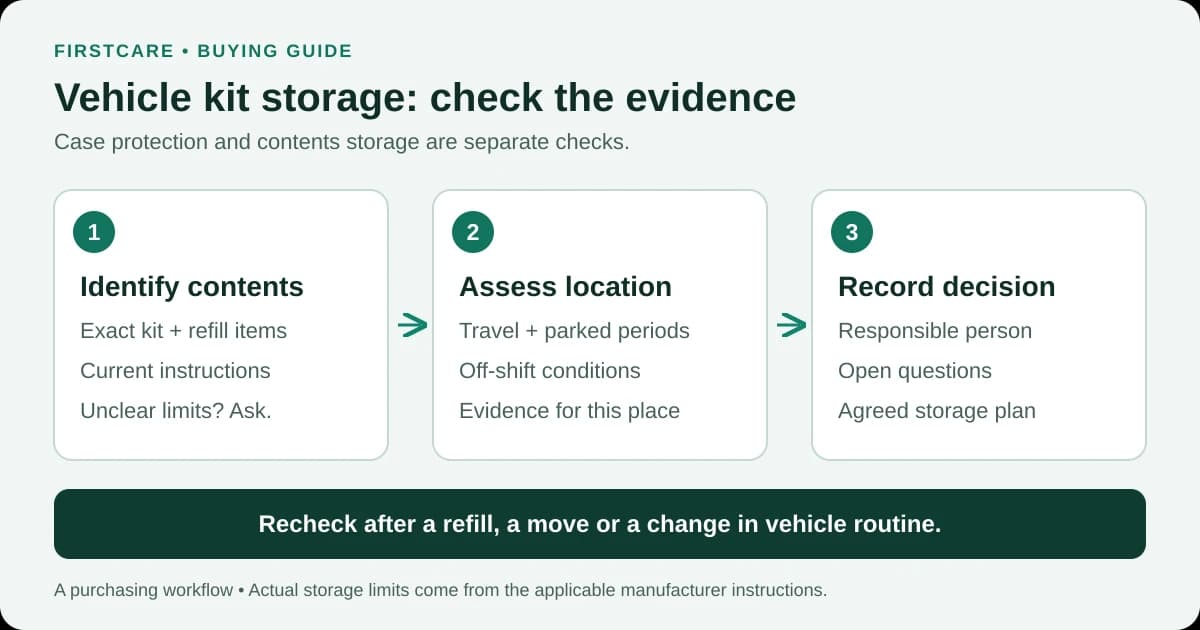
Choose a first aid kit storage location by matching the exact contents’ manufacturer instructions to the conditions where the kit will stay, including parked and off-shift periods. A durable case or an unexpired label alone does not establish that every item is suitable for that location.
Check the case and its contents separately
A portable kit solves a carrying problem. Before accepting it for a vehicle, confirm the storage requirements of the filled kit and the individual products inside. Case material, dimensions and resistance to dust or moisture answer different questions from the permitted storage conditions of consumables.
For a concrete manufacturer example, Cederroth’s First Aid Kit Medium, REF 390101, specification version 06 (issued 11 May 2026) describes protection from dust, dirt and moisture, but separately specifies dry storage at room temperature and retaining original packaging until use. Our purchasing conclusion is that the case description alone is insufficient evidence for leaving its contents in a parked vehicle.
This example illustrates how to read a specification. It does not establish FirstCare stock, an approved UAE vehicle kit or storage limits for another model. Obtain the current instructions for the products actually offered.
Describe the whole storage journey
For a UAE mobile team, identify the exact proposed compartment and what happens before, during and after the working day. A description such as “air-conditioned vehicle” leaves unanswered what happens when the vehicle is parked and its cooling is off.
Use the same process for GCC sites, with each location’s real conditions and applicable site arrangements. This is a purchasing assessment, not a country-wide temperature rule. Ask the responsible safety or facilities person what measurements or other reliable evidence are needed to compare the location with the manufacturer’s instructions.
| Stage | Question to resolve |
|---|---|
| At the base | Where is the kit held before issue, and who confirms the storage instructions? |
| During travel | Which compartment holds it, and what evidence describes conditions there? |
| While parked | What happens during stops, off-shift parking and weekends when cooling may be off? |
| At the work location | Where will the kit remain accessible and protected while the team works? |
| On return | Who receives it, records concerns and confirms the next storage location? |
Build a storage evidence record
Keep the product instruction and the location assessment together. The following is a proposed internal record, not an official UAE inspection form. Record unresolved fields explicitly rather than treating a missing instruction as permission.
Where a manufacturer uses a term such as room temperature without numerical limits, request clarification for the intended setting. Do not assign your own range, copy a limit from another brand or average different products’ requirements.
| Record | Evidence to keep |
|---|---|
| Exact contents | Kit reference, item-level inventory and added or substituted products |
| Manufacturer instructions | Document title, revision and relevant storage conditions for each affected item |
| Proposed location | Vehicle or station ID, compartment, working hours and off-shift arrangement |
| Location evidence | What was assessed or measured, where and when, and any unassessed periods |
| Decision and follow-up | Responsible person, unresolved questions, supplier response and agreed action |
| Review trigger | A changed refill, storage location, vehicle routine or reported condition concern |
Resolve a vehicle quotation that leaves storage unclear
Illustrative enquiry: a supplier offers a portable kit described as moisture-resistant, but the attached instructions require room-temperature storage. The buyer plans to leave it in a vehicle overnight and has not assessed that compartment.
The open issue is the match between the instructions and the location. Ask the supplier to identify the applicable documents, and ask the responsible person to assess the proposed conditions. A carrying handle, larger box or moisture claim does not close that evidence gap.
If another storage arrangement is needed, include access and responsibility in the decision. Moving a kit to an indoor store requires a clear issue-and-return process and a plan for the people who still need supplies. Do not assume a different bag, insulation or cooling accessory maintains the required conditions without supporting evidence.
Recheck storage when the contents change
Refills can change the manufacturer, formulation, packaging or instructions of an item even when the outer kit stays the same. Compare a proposed replacement with the recorded requirements before accepting the substitution; keep the new document with the inventory.
Cederroth’s FAQ distinguishes the temperature tolerance of storage units from that of their contents and notes that incorrect storage can affect product properties, including plaster adhesion. Its symbols guide also distinguishes temperature limits, keeping products dry and damaged packaging. These are manufacturer examples, not a universal limit for mixed-brand kits.
If there is a suspected storage excursion or damaged packaging, record the affected items and the known conditions, and obtain the manufacturer’s advice through the supplier and your responsible person. Follow your site’s process for holding uncertain supplies pending review and maintaining suitable first aid provision. A future expiry date or normal appearance alone does not resolve a storage concern.
Send a supplier enquiry that can be answered
Adapt this wording to the kit and location: “Please identify the filled-kit model and itemised contents, provide the current manufacturer storage instructions, and identify any different requirements for proposed refills. The intended location is [vehicle/station and compartment], including [parked and off-shift periods]. Please clarify any instruction that does not let us assess that location and state what evidence supports the proposed storage arrangement.”
Keep storage suitability, remaining shelf life and the refill schedule as separate checks. The related guides below cover those other decisions in detail.
Common questions
Can I leave a first aid kit in a UAE vehicle all year?
Assess the exact products and the intended compartment against the manufacturer’s instructions, including parked and off-shift conditions. A portable-kit label alone cannot establish suitability for year-round vehicle storage.
Does a moisture-resistant case keep the contents within their storage temperature limits?
A moisture-protection claim does not establish temperature control. Request the separate storage requirements for the contents and evidence that the proposed arrangement meets them.
What temperature should I use for a mixed first aid kit?
Use the instructions for the actual kit and its products, including any refills. Request clarification where limits are unclear; do not invent one numerical range or average different item requirements.
Does an unexpired date settle a storage concern?
No. Keep expiry and storage-condition checks separate. Record the concern and seek manufacturer clarification through the supplier and responsible person before closing the review.
Related guides and equipment
Prepared with AI assistance. Procurement information, not clinical instructions or an approval certificate. Requirements depend on the applicable authority and your workplace. Sources, corrections and editorial policy.