
FirstCare buying journal
Burn Kits and Dressings: UAE Buying Checklist
Compare burn kits, dressings and refill offers for UAE workplaces. Check item references, pack quantities, shelf-life evidence, storage and receipt records.
By FirstCare First Aid · Published · Updated
The short answer
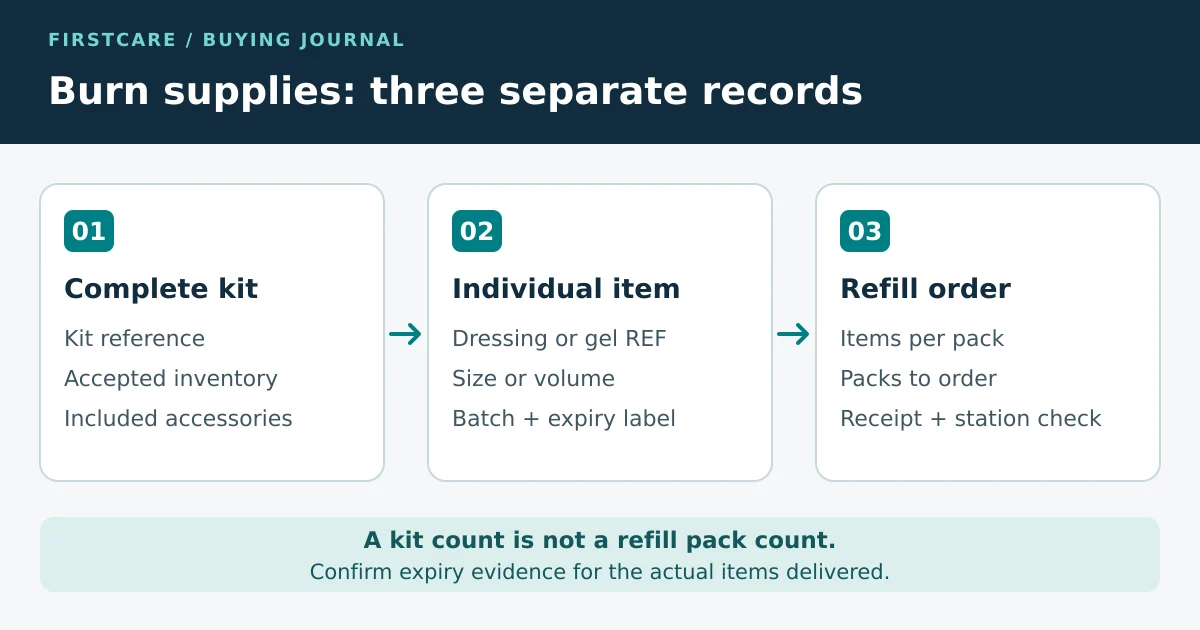
Before ordering burn supplies for a UAE workplace, obtain the site’s approved specification and separate the complete kit from individual dressings, gels and refill packs. Compare exact item references, dimensions, quantities, shelf-life evidence and storage instructions. A burn-kit label or total item count alone does not show that two offers meet the same requirements.
Confirm the workplace requirement before choosing products
Have the responsible workplace safety or medical team define the burn supplies needed for the actual work and the personnel trained to use them. Record the site, intended station and accepted contents list. Product selection and clinical response belong in those qualified arrangements; this guide addresses the purchasing record.
For Abu Dhabi, ADPHC’s ADOSH-SF CoP 4.0, version 4.0 dated 15 July 2024, section 3.1.1.3(c),(d) links first aid resources to assessed risks and first-aider competency. Section 3.3(d) requires at least Appendix 1 contents, with stricter regulations taking precedence. This source does not establish that one commercial burn kit meets every UAE or GCC site’s needs.
Separate a complete burn kit from its refill products
Ask the supplier to identify what each quoted line actually supplies. Keep dimensions for a dressing separate from dimensions for the outer case, and distinguish the number of individual items from the number of retail packs. The following are purchasing distinctions, not clinical alternatives.
| Quoted item | Details needed to compare it |
|---|---|
| Complete burn kit | Kit manufacturer and reference; itemised inventory; case, instructions and accessories included. |
| Individual burn dressing | Exact item reference, dressing dimensions, packaging description and number of dressings per sale unit. |
| Gel bottle or sachet | Exact formulation/product reference, volume per container and containers per sale unit. Do not count it as a dressing. |
| Refill assortment | Every included reference and quantity; whether it restores the accepted inventory or supplies only selected items. |
Manufacturer example: kit contents and retail packs are different counts
Cederroth’s linked specification for kit REF 51011013 lists four 10 × 10 cm dressings (refill REF 901900) and two 20 × 20 cm dressings (REF 51011015), among other contents. Its individual product pages list REF 901900 as a two-pack and REF 51011015 as a one-pack. Keep the kit reference, component reference and order unit in separate fields.
The table shows only these two lines from one manufacturer’s kit. It is not the full inventory, a recommended burn provision or a claim that FirstCare stocks this brand. Confirm the actual offered model and current supply configuration with sales.
| Selected component | Inside one example kit | Listed retail pack |
|---|---|---|
| 10 × 10 cm dressing · REF 901900 | 4 individual dressings | 2 dressings per pack |
| 20 × 20 cm dressing · REF 51011015 | 2 individual dressings | 1 dressing per pack |
Check which product a shelf-life statement describes
The kit specification linked above states three years from production for REF 51011013. The individual dressing pages state five years. These statements describe different product scopes; neither promises the remaining shelf life of the goods delivered to your site. The linked kit document is dated 2020, so ask for the current specification and labels for the actual quotation.
Request expiry information for the supplied items and agree any minimum remaining shelf life at receipt. If an offer simply says “five-year burn kit”, ask whether that refers to the assembled kit, a component, an original manufacturing period or time remaining at delivery. Leave the point unresolved until the supplier gives model-specific evidence.
The same kit specification calls for dry storage at room temperature and keeping contents in their original packaging until use. Record the actual storage location and obtain instructions for the proposed items; a closed carry case does not establish suitability for a hot vehicle or a position beside an oven.
Resolve substitutions and packaging questions before acceptance
A proposal to replace a requested dressing with gel, another dressing size or another product formulation needs an explicit decision from the responsible reviewer. Similar naming, the same total number of pieces or the same nominal dimensions cannot establish clinical equivalence.
Ask for current manufacturer instructions and the offered item’s packaging information. Cederroth’s two cited dressing pages warn against use when packaging is open or damaged and against reuse. For receiving checks, record packaging condition and refer discrepancies to the responsible person; opening a unit to demonstrate the contents can change its acceptance status.
Carry the accepted order into the station record
At receipt, compare each delivered line with the accepted inventory, not just the kit name on the carton. Record item reference, quantity, batch or lot where shown, expiry information and assigned station. Keep short deliveries, changed references and damaged packaging open until resolved.
For later refills, identify the component reference and order unit separately from the outer kit reference. Check the restored station as well as any reserve stock. Do not retain an old kit-level date as the only record after replacing its consumables.
- Send the site and station identifier, accepted inventory revision and required quantities.
- Request the complete kit or named refill items explicitly, including pack quantities and dimensions.
- Ask for current instructions, expiry evidence, storage conditions and a written list of proposed differences.
- Confirm price, availability, delivery destination and agreed terms in the quotation; this article supplies none of those commitments.
Common questions
Does a specialist burn kit replace the general workplace first aid kit?
Do not assume it does. Compare its full inventory with the workplace’s required provision. Have the responsible person approve how specialist supplies fit into the wider station plan.
Does the number of items on a burn kit label tell me how many dressings it contains?
No. The total can include bottles, bandages, gloves and accessories. Request the itemised inventory and distinguish individual dressings from retail refill packs.
Can I accept a longer component shelf life as the expiry date for the whole kit?
No. Establish what the statement covers, inspect the actual supplied labels and record the relevant item dates. Agree remaining shelf life at receipt separately from a manufacturer’s original shelf-life statement.
Related guides and equipment
Prepared with AI assistance. Procurement information, not clinical instructions or an approval certificate. Requirements depend on the applicable authority and your workplace. Sources, corrections and editorial policy.