
Workplace access and kit selection
Wall-Mounted vs Portable First Aid Kits: UAE Buying Guide
Compare fixed first aid stations, portable kits and removable wall cases. Plan access, mounting and site coverage when a mobile team leaves the workplace.
By FirstCare First Aid · Published · Updated
The short answer
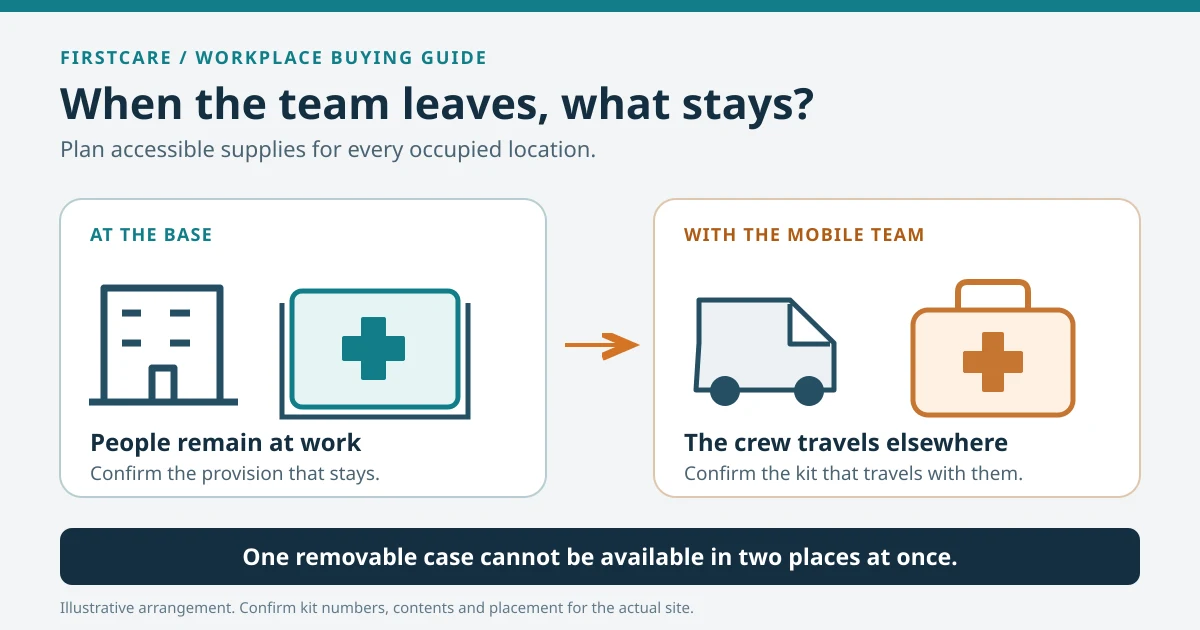
Choose the format around where people work and how they can reach the supplies. A fixed station gives a known location; a portable kit can accompany a team. If people remain at the base while a kit leaves with a vehicle or crew, review the provision for both places. A removable wall case is still only one kit, and the contents and number of stations need a separate site assessment.
Start with the workday, not the container
Draw the occupied areas and the routes staff take during a normal shift. Include reception closing times, locked store rooms, separate floors and teams leaving for customer sites. Ask where each group would find its supplies at those times. This often reveals a more useful question than whether a metal box looks stronger than a bag.
The UK HSE assessment guidance includes work patterns and the needs of travelling, remote and lone workers. Those are useful planning prompts here; the HSE page describes the UK framework, not UAE legal requirements. Your responsible safety person should confirm the local provisions for each premises.
Check the local placement requirements before combining stations
For Abu Dhabi, ADOSH-SF CoP 4.0, version 4.0 of 15 July 2024, section 3.3 requires kits in worksite vehicles and at least one on each office-building floor. It also requires a risk assessment of kit numbers and contents and easy, quick access to the container.
That Abu Dhabi provision should be checked before treating one travelling box as the provision for both a vehicle and a building. Other emirates and GCC countries have their own applicable requirements. This article does not set a universal ratio, mounting height or inventory.
Compare three storage arrangements
Use this comparison to brief the supplier and the person responsible for the site. These are practical design questions, not a certification checklist. A container choice does not by itself establish that the contents or the overall first aid arrangements are suitable.
| Arrangement | What to confirm |
|---|---|
| Fixed wall station or cabinet | Staff can reach it during every occupied shift; doors, furniture and access controls do not obstruct the route. |
| Portable kit assigned to a team | The kit goes with the people it serves; the carry arrangement, storage location and handover owner are clear. |
| Removable case on a wall bracket | The exact case and bracket are compatible, removal is practical, and the plan covers the area left behind when the case leaves. |
A removable wall case is still one physical kit
Portable and wall-mounted are not always mutually exclusive. As a manufacturer example, Cederroth describes its First Aid Kit Large, reference 390102, as a handled portable case. Its bracket reference 190400 lists that case among the compatible models.
This illustrates why a bracket and a carrying handle cannot be counted as two stations. It does not establish compatibility for another brand or confirm FirstCare stock, supply, contents or local approval for those Cederroth models. Request the exact proposed model and accessory references in your quotation.
Ask for mounting and storage details that can be checked
For a fixed unit, send the proposed location and ask your installer to confirm the wall, fixings and manufacturer instructions. For a carried unit, check the loaded case rather than an empty demonstration sample. Keep the container specification and the consumables’ storage instructions as separate records.
- Mounting: compatible bracket, included accessories, loaded weight and responsibility for supply and installation of fixings.
- Access: space to open the lid or door, remove the case where intended and reach the station during each shift.
- Carrying: usable handle or strap, secure closure, internal organisation and a practical place to put the opened kit.
- Storage: written temperature, moisture and other limits for the actual contents; do not infer suitability for a parked vehicle or outdoor location from the case material.
- Order scope: empty container, filled kit, bracket and refill items shown on separate lines, with exclusions visible.
Walk through the moment the mobile team leaves
Illustrative scenario: a maintenance crew collects the only removable case from a warehouse wall and drives to another site. Warehouse staff remain at work. The empty bracket still marks a location, but the supplies are now elsewhere. Review what accessible provision remains for the warehouse and what the travelling crew needs.
Resolve that gap in the site plan before accepting the arrangement. Depending on the assessment and local requirements, a separate portable kit may be needed alongside fixed provision. Do not assume the solution is simply to divide one approved contents list between two half-filled containers.
Use a short handover record: kit identifier, team or vehicle, departure and return, the provision remaining at the base, and the person checking condition and replenishment. This is an optional operational record, not a prescribed legal form. Update it when team routes or work areas change.
Make the supplier demonstrate the proposed arrangement
Request photographs or model documentation showing the case open, closed and mounted where applicable. Have the site team review the actual access route and intended storage conditions. Resolve missing mounting parts, awkward removal or unclear contents before closing the purchase record.
For a FirstCare enquiry, send the workplace location, fixed and mobile areas, confirmed contents schedule and the arrangement you want priced. If you already own a suitable container, identify it clearly when asking about a refill. Final model, compatibility, contents and delivery terms should be stated in the written quotation.
Common questions
Is a wall-mounted first aid kit always better than a portable kit?
Neither format is automatically better for every workplace. Compare access during occupied hours, mobile work, the contents needed and the applicable site requirements. Some arrangements need fixed provision and a separate travelling kit.
Can I use one removable wall kit for the office and the vehicle?
Check what remains available in the office when the kit leaves, as well as any requirement for vehicle provision. A bracket and handle are two features of one kit. Have your responsible safety person confirm the arrangement before counting it toward both locations.
Does a wall bracket come with every portable first aid kit?
Do not assume it is included or compatible. Ask the supplier to identify the exact case, bracket and fixings, state which accessories are included and provide the relevant manufacturer instructions.
Can a hard case be left in a parked vehicle?
The material alone does not answer that question. Confirm storage limits for the supplied contents and the conditions in the intended location with your responsible team and supplier. Do not treat an outdoor-looking case as proof of heat protection.
Related guides and equipment
Prepared with AI assistance. Procurement information, not clinical instructions or an approval certificate. Requirements depend on the applicable authority and your workplace. Sources, corrections and editorial policy.