
FirstCare buying journal
First Aid Kit Batch Records & Safety Notices: UAE Guide
Trace first aid components across UAE workplace kits: record product and batch identifiers, check safety notices and reconcile station transfers with a worked example.
By FirstCare First Aid · Published · Updated
The short answer
Record each component’s product reference, batch or serial identifier where supplied, quantity and current location when receiving and refilling first aid kits. If a safety notice arrives, verify its source and match all the identifiers it specifies. Trace transfers between stations, keep missing information unresolved and record completion of the notice’s actual instructions.
Keep the component identity separate from the kit name
A kit can contain several products and batches after refilling. For your purchasing record, keep the outer kit model as the container reference and give each identifiable component its own entry. An invoice description such as “first aid refill” is insufficient for matching an individual dressing to a batch-specific notice.
Australia’s TGA distinguishes the UDI device identifier, which identifies a model or version, from production identifiers that may include lot, serial or expiry information. This explains the labels; it does not establish a UAE UDI requirement for every first aid item. A product identifier alone is not its batch number.
Verify the notice before deciding which stock it covers
Check the manufacturer’s official notice and any applicable local authority communication. Save the notice reference, issue date and revision. Compare its stated product, model, part number and batch or serial scope with the labels you hold. UK MHRA manufacturer guidance describes these identifiers and clear actions as important notice content; it is UK guidance, not a UAE workplace rule.
For Dubai private healthcare facilities and practitioners, DHA’s circular channel is a relevant official source. Its 7 September 2026 safety-alert circular relays Emirates Drug Establishment communications to that audience. This example does not establish requirements for every UAE workplace, or announce a recall of FirstCare products.
Use contact details independently verified on the issuer’s official website or your established supplier record. A forwarded screenshot may omit an attachment or later revision. Where applicability is unclear, ask the supplier or issuer to confirm the exact notice and product scope.
Worked example: one batch distributed across four locations
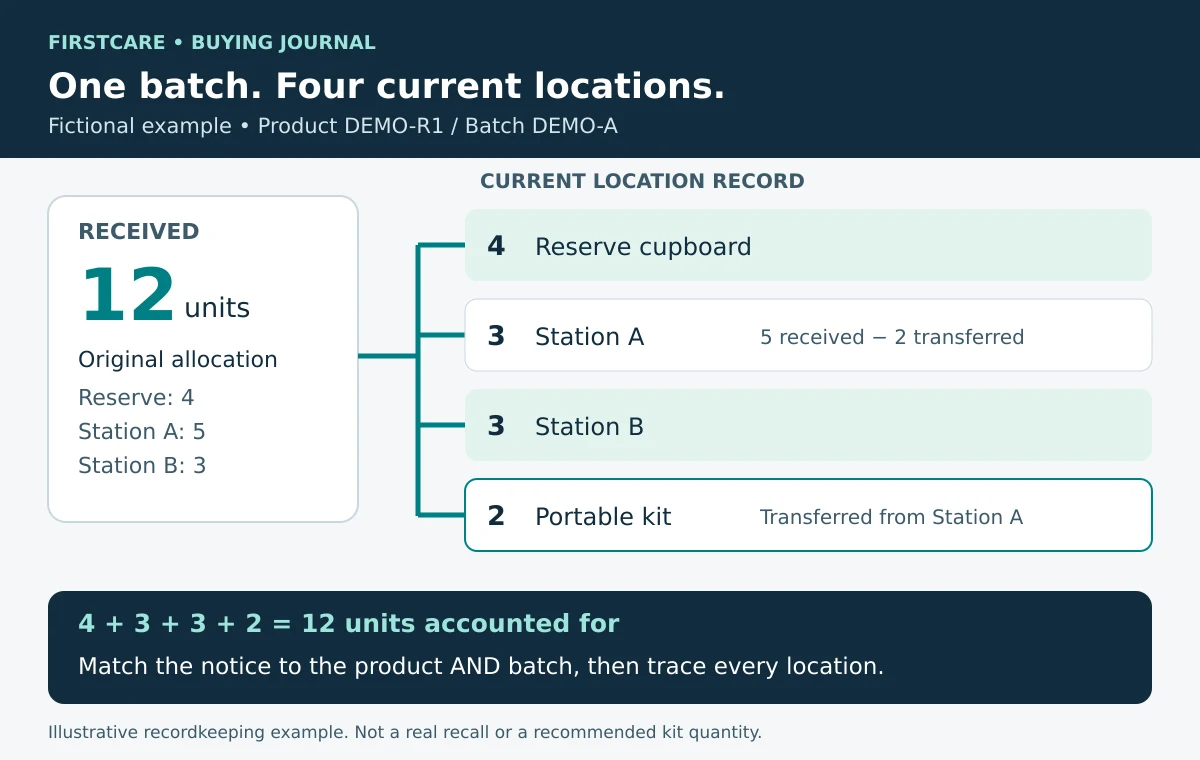
This fictional example uses product DEMO-R1 and batch DEMO-A. It is not a real product alert or a recommended kit quantity. Twelve units arrive: four stay in reserve, five go to Station A and three to Station B. Station A then transfers two units to a portable kit.
The current location record below still totals 12. If a hypothetical notice names DEMO-R1 and DEMO-A, checking only the reserve cupboard would miss eight units. The original delivery allocation would also send the checker to the wrong location for two units.
| Current location | Units and movement record |
|---|---|
| Reserve cupboard | 4 units retained from the delivery |
| Station A | 3 units remain after transferring 2 |
| Station B | 3 units received; no later movement in this example |
| Portable kit | 2 units transferred from Station A |
| Reconciled total | 12 units: 4 + 3 + 3 + 2 |
Keep missing labels and unexplained quantities open
Use the movement record to guide a physical check of the named locations. Compare product and batch identifiers together: the same product reference may occur in several batches. If a notice states that all batches are affected, do not narrow it to the batch in your example or purchase record.
If only 11 of the 12 example units can be accounted for, record one unresolved unit and investigate the movement history. A documented use or return may explain it; a guessed explanation cannot close the gap. If stock was sent to another site, give its responsible team the verified notice and record its response.
A missing batch label means the match is unresolved. Ask the supplier or manufacturer what evidence can identify the item and what to do while that question is open. Keep packaging intact, including sterile wrappers. Do not mark unidentified stock as unaffected merely because its batch is absent from your spreadsheet.
Record the required action separately from the stock count
The FDA explains that a medical-device recall can involve a correction or removal, and does not invariably require a return. That is US terminology, not UAE legal advice. Follow the authenticated notice and applicable local instructions for the actual item; do not invent a disposal, repair or stop-use instruction.
For an internal follow-up record, the fields below connect the count to evidence of action. Where the instructed action leaves a station short, ask the responsible site team to arrange suitable interim provision and approve replacement specifications.
| Record field | Useful evidence to keep |
|---|---|
| Notice and scope | Reference, revision, official source and the identifiers checked |
| Location reconciliation | Units found, documented movements and unresolved quantities |
| Action and owner | The issuer’s instruction, stated deadline and person handling it |
| Completion evidence | Dated confirmation, requested acknowledgement, return receipt or other evidence appropriate to that notice |
| Open points | Unidentified stock, missing responses and any replacement still awaiting approval |
Ask for usable batch information in the next supply order
Ask whether the supplier can provide component references, batch or serial information where applicable, and a packing list that separates multiple batches. Confirm how product notices will reach your organisation and how a contact change should be reported. Request this information before accepting a quotation if it is part of your site’s purchasing specification.
At receipt, check the actual labels against the documents and retain a readable record. Update locations when refilling or transferring stock. These are procurement and recordkeeping suggestions; they do not certify a kit, set a legal retention period or replace your organisation’s incident procedures.
Common questions
Is the first aid kit model number enough to check a component safety notice?
Keep the kit model for the container record, but match the actual component identifiers requested by the notice. Refilling can introduce different products and batches into the same kit.
Can I mark an item unaffected if its batch number is missing?
No. Keep its status unresolved and ask the supplier or manufacturer how to establish its identity and handle the uncertainty. Missing data is not evidence that the notice excludes it.
Does every product recall require throwing the item away?
Follow the authenticated notice for the specific product and applicable local instructions. Different notices can require different actions; a generic recall headline is not a disposal instruction.
Related guides and equipment
Prepared with AI assistance. Procurement information, not clinical instructions or an approval certificate. Requirements depend on the applicable authority and your workplace. Sources, corrections and editorial policy.