
FirstCare buying journal
Blue vs Detectable Plasters: UAE First Aid Buying Guide
Compare blue, metal-detectable and X-ray-detectable plasters before specifying first aid kit refills for UAE kitchens, hotels and food production sites.
By FirstCare First Aid · Published · Updated
The short answer
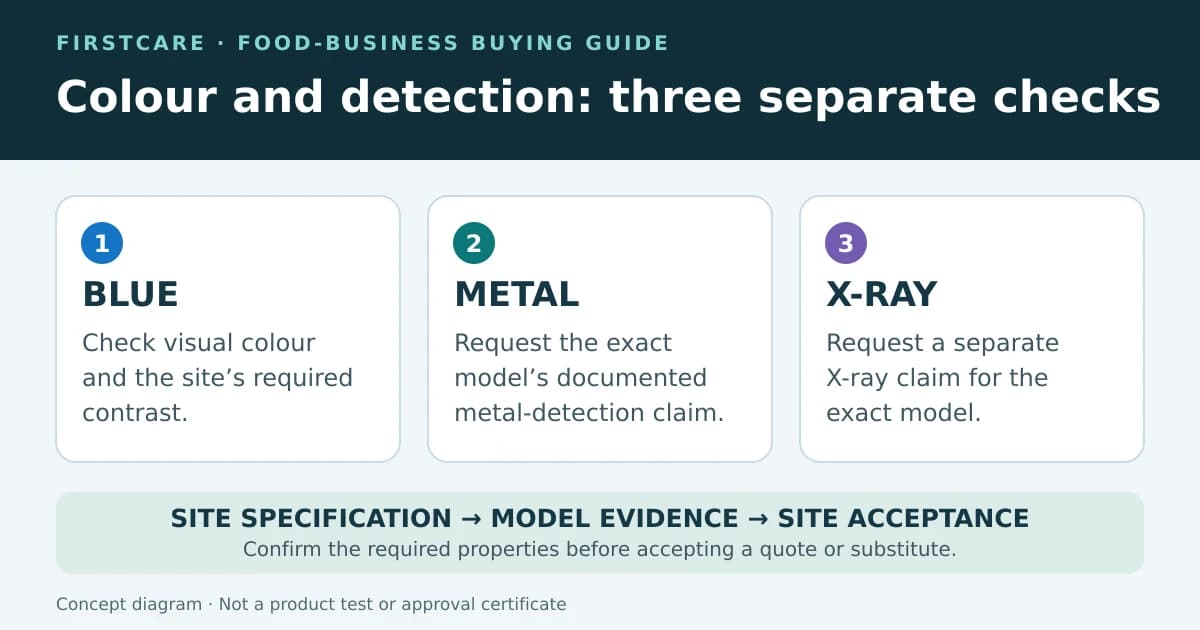
Blue colour alone does not establish metal or X-ray detectability. For a food-business first aid kit, ask for the exact plaster model and manufacturer evidence for each required property. Have the site’s food-safety lead confirm that the proposed item meets the site specification before ordering or accepting a substitute.
Start with the food business’s approved specification
A hotel kitchen, catering operation and food production line may have different purchasing specifications. Give the supplier the intended area and the site-approved requirements instead of ordering a generic “food-safe first aid kit”.
The FAO/WHO General Principles of Food Hygiene, revised in 2022, discusses suitable waterproof plasters and measures to prevent them becoming a contamination source. Section 12.2 gives contrasting colour and metal or X-ray detection as examples. It also addresses whether an injured person should be assigned away from direct food contact. Buying a particular plaster does not decide fitness for work.
This is international food-hygiene guidance, not evidence of a universal UAE or GCC product mandate. Confirm applicable local requirements and the workplace procedure with the responsible team.
Keep colour and detection claims separate
Use three separate fields in the purchasing specification. The distinction below follows the different properties described in the manufacturer examples that follow; it is not a performance test of any product.
| Property on the quote | Evidence to request |
|---|---|
| Blue colour | The exact model’s colour and the site’s required visual contrast. A blue photograph does not establish electronic detectability. |
| Metal detectability | A manufacturer statement for that model, including any stated limitations. Do not automatically extend this claim to X-ray detection. |
| X-ray detectability | An explicit X-ray claim for that model. If both detection methods are required, ask for evidence of both. |
Two manufacturer examples show why the model matters
Cederroth describes Salvequick Blue Detectable Plaster, REF 51030127, as detectable by most food-industry metal detectors. Its page separately describes the blue colour’s visibility. That qualified statement is not a guarantee for every detector, and the cited page does not establish an X-ray claim for this model.
The manufacturer’s separate Salvequick Blue X-Ray Detectable Plaster page, REF 510003320, expressly lists both metal and X-ray detectability, as well as waterproofness. These are manufacturer-stated properties of that specific model.
These examples explain how to read a specification. They do not confirm FirstCare stock, UAE approval or performance on your production line. Ask the responsible food-safety team what acceptance evidence is needed for the actual site and its equipment.
Resolve an incomplete quote before comparing prices
Illustrative example: a food production site has approved a specification requiring both metal and X-ray detectability. One supplier quotes “blue catering plasters”; another identifies a model and supplies documentation for both properties. The first offer is incomplete for comparison until the supplier identifies the model and supports the required claims.
This does not prove that the unnamed item is unsuitable. It identifies missing evidence. Record the open question, obtain the document and let the site’s responsible person accept or reject the proposed item. Avoid treating a “HACCP” phrase or logo as a substitute for the exact product specification.
Keep the approved item identifiable when refilling
Once a model is accepted, record enough information to prevent an accidental change during the next refill. A replacement described only as “same blue plaster” leaves important questions unanswered.
- Manufacturer, exact reference and the document used to confirm the required colour, waterproofness and detection properties.
- Required sizes, pack format and compatibility with any existing dispenser, confirmed for the proposed refill.
- Who may approve a different model and which evidence must be checked before a substitution is accepted.
- The receiving check that matches the delivered model to the accepted specification and records any unresolved difference.
Prepare a UAE or GCC supplier enquiry
State the delivery location, food-business activity and the exact first aid station or dispenser being replenished. Attach the site specification and ask the supplier to identify any requirement their proposed item does not yet demonstrate.
For an enquiry covering several GCC countries, keep each site’s acceptance requirements identifiable. Do not assume that one country’s requirement, one manufacturer statement or one customer’s approval applies to every destination. Use the related refill guide for the wider stock check and keep the food-specific product decision with the responsible food-safety team.
Common questions
Are all blue plasters metal detectable?
Do not infer metal detectability from colour. Request the exact model reference and its manufacturer specification; a blue image or a generic catering description is not enough evidence.
Does metal detectable also mean X-ray detectable?
Do not assume the two claims are interchangeable. Ask for an explicit statement covering each detection method required by your site.
Is this an approved UAE food-business first aid contents list?
No. This guide helps buyers check plaster specifications. Your responsible team must confirm the applicable local requirements and the complete approved inventory for the workplace.
Related guides and equipment
Prepared with AI assistance. Procurement information, not clinical instructions or an approval certificate. Requirements depend on the applicable authority and your workplace. Sources, corrections and editorial policy.